
The Client Retention Handbook
For Digital Marketing Agencies

The Client Retention Handbook For Digital Marketing Agencies
Copyright © 2022 by Josh Nelson. All rights reserved.
This publication is licensed to the individual reader only. Duplication or distribution by any means, including email, disk, photocopy, and recording, to a person other than the original purchaser is a violation of international copyright law.
Publisher: Seven Figure Agency LLC, 9555 SW 175 Terrace, #519, Palmetto Bay, FL 33157
by Ryan Deiss

When Josh Nelson shared with me the concept for his new book — the book you now have in your hands — I knew it would be a winner.
Too often, agency owners focus more on landing clients than keeping them.
I’ve been there too. There’s something invigorating about onboarding a new client. But, as Josh so expertly describes in this book, acquiring new clients is only half the battle. Your business should be putting just as much effort — if not more — into retaining those clients.
Maybe you know how important retention is, but you just don’t know how to get there. If so, this book can become a valuable lifeline for your agency.
Josh’s insight into client retention is fresh, descriptive, and valuable. First, he details why retention matters, using personal experience to highlight what happens when you don’t prioritize retention.
Then, Josh lays out detailed steps to follow within the first 90 days of a client relationship to ensure that new clients turn into long-term partnerships. These steps are creative, purposeful, and attainable.
Each section ends with a Retention Roadmap Action Step that details clear instructions to implement these strategies in your own agency.
I’ve seen many agencies lose momentum when it comes to ongoing communication with clients. They focus more energy on the first few weeks of a client relationship and much less on the months and years ahead. And that’s what leads to the unsatisfactory experiences that ultimately drive clients away.
Josh knows what it takes to retain clients long-term. He’s a highly successful digital marketing agency owner and the founder of Seven Figure Agency, a mentorship group with the goal of helping 500 agencies reach seven figures over the next five years.
I challenge you to read this book cover to cover and put Josh’s roadmap to work. See what happens in the days, weeks, and months after putting this retention plan to work in your agency.
—RYAN DEISS
Founder and CEO of DigitalMarketer & Scaleable Company
After years of hard work and dedication my business partner Dean & I had grown our agency Plumbing & HVAC SEO to a Seven Figure Business! We had done the hard work to build our brand, position ourselves as the experts in our niche, land new clients on a consistent basis, and put a team in place to deliver great results to our clients, but there was a problem…we were losing too many clients. Just when we felt we’d hit our stride, landing 5-7 new clients per month on retainers of $1,500—$2,000 monthly, we noticed our growth start to slow. As our base of clients grew so did our attrition rate.
It was so frustrating because we felt like we were doing such a great job serving our clients. We really cared about them, their results, and the outcomes we were able to deliver for them. After we had poured our heart & soul into getting them as a client, getting them set up & doing everything we could to make it rain for them, it felt like a dagger through the soul getting that email that says, “We need to talk” or “We’re going another direction.”
One afternoon I was meeting with a friend of mine, Brian Kaskavalciyan from GFour Marketing Group, at our office in Miami, and he happened to notice my sales tracking board (I had a big board where I tracked our new clients sold & lost any given month.) He said “Wow, you guys landed 10 clients this month…that’s impressive…but you lost 8.” “Ouch!” At the time I was aware there was a problem but didn’t want to focus on it. His observation really made me think. Were we losing too many clients? How could we continue to grow if we were losing clients almost as quickly as we were gaining them? What could we do to improve in this area?
As I analyzed it further, I learned that the average churn rate for agency services is around 10-15% monthly on retainer-based services. So, if you have 10 clients you might lose 1-2 clients per month. If you have 50 clients, you might lose 5-7 clients per month. We had grown our agency over the years by consistently landing 5-7 clients per month. So, for the first 30-40 clients ($45,000 or so in Monthly Recurring Revenue) we were way ahead of churn, but once we got to 50 clients, things really started to slow down because if we kept only landing 5-7 clients per month and had a 10% churn rate, we would lose an average of 5 clients per month. I distinctly remember pondering this in the shower (where I do some of my best thought work) and getting this pit in my stomach…if something didn’t change, we would stagnate and eventually start to go backwards. Eventually, at around 70-80 clients per month (staying at a 10% monthly churn rate) we would have to sell 7-8 new clients just to remain even.
At that point I knew something had to change. I went on a quest to figure out what could be done to reduce our churn, maximize retention & change the outcome in our agency. I studied all the best books, courses, and experts that I could find on client services, account management, client retention strategies and started testing them in our agency.
I identified 3 key areas that had the biggest impact on our ability to retain clients (the sticky triad) and implemented them. The results were not immediate, but over time we saw a major improvement in our ability to retain clients, and we improved our average monthly retention rate from around 93% to over 98% monthly (less than 2% churn). This had a HUGE impact on our ability to grow the business. Our agency grew to over 185 clients / $425K monthly recurring revenue and went on to make the Inc 5000 list of fastest growing companies in the United States 4 years in a row (2016—2019).
So, I can tell you first-hand that dialing in your client retention will not only make you more money & more successful, but it will also make your agency a lot more fun. In the pages of this book, I’ll share the key insights I discovered and the changes we made to improve our client retention. You’ll get the step-by-step playbook that you can implement to delight your clients, provide a world class experience & retain clients at a level others think is impossible.
Let’s get to work…
My name is Josh Nelson. I am the founder of Plumbing & HVAC SEO, a full-service digital marketing agency serving the plumbing & HVAC niche which I’ve grown from zero to over $4.5 Million per year. I also run a coaching & training program called Seven Figure Agency that helps other agencies grow & scale. I can teach you how to land clients, deliver excellent systematized results, retain your clients at the highest level possible and scale your business.

I work with a lot of agencies in different stages of growth.
In their early stages, agencies often peak at a certain level because they’re spread too thin, and their marketing is ineffective. They don’t have enough leads, appointments, clients, or money.
My job is to help them launch and double their income quickly.
At the other end of the spectrum, my Seven Figure Agency Mastermind, Mentorship & Mastery program is for agency owners already earning $15,000 a month or more.
My job is to help them scale their business and give them three things:
I help them build a business that is the basis for a wonderful, liberated, full life.
For agencies of all sizes, I find that one of their biggest challenges is they are seeing too much churn and they want to encourage more clients to stay on board longer.
This book, “The Client Retention Handbook for Digital Marketing Agencies,” provides a roadmap for agencies of all sizes that want to keep clients on board long-term and reduce churn. I trust it will be a game changer for you.
WORKBOOK

While there are hundreds of trainings focused on ‘getting’ clients, nobody tells you the harsh reality:
And this is a big deal because…
So how do you get them to stay?
Believe it or not, it’s not just about results.
You’ve probably experienced this yourself, and often wondered “why did they leave?”
Well, getting clients to stay with you longer all boils down to 3 key elements I refer to as “the sticky triad” and you have to get all your ducks in a row…
If you’re reading this now—chances are you’re frustrated (like I was) because you haven’t quite figured out HOW to do that, and it’s one of the biggest factors that’s holding your agency back from getting out of the “cycle of stuck,” building your team, and enjoying the sort of lifestyle most people only dream of.
In this book, you’re getting the exact step-by-step processes we used to keep more clients as we grew exponentially to become a seven figure agency in less than two years (and make the INC 5000 list four years in a row,) which have now been modeled by hundreds of agency owners.
In my book, The Seven Figure Agency Roadmap, I outline the following three pillars to building a highly profitable agency:
Each of these is crucial and you could be great at one of them and still fail in business if you don’t master the other two.
However, it seems the biggest challenge for many marketing agencies as they grow is to keep clients once they have them on board.
We are all marketing specialists and perhaps we are most excited and experienced in client attraction.
Yet the harsh reality is you can’t build a marketing agency that is sustainable and rewarding if can’t keep clients with you for the long-term.
You need to think beyond just landing clients and putting more emphasis on ensuring clients stick around for years.
I wrote this book to provide a roadmap for achieving that.
This shares my experience of the actions we have taken in my agency to improve our client retention and profitability. I’ll share with you the specific actions you need to take to avoid the mistakes that we made.
You’ll also benefit from the experience of some of the successful members of our Seven Figure Agency group and be able to model the specific actions they have taken.
No matter how good we are as agency owners, no matter how great our services (Websites, SEO, PPC, Social Media, Funnels, Marketing Automation, Etc.) no matter how nice we think we are, clients will cancel.
And it’s painful. We feel destroyed when a client cancels on us. I know that I’ve lost sleep more than once over losing a very important client.
While this book is about how we change the dynamic and retain the clients for the longest time possible, the reality is that clients are going to cancel. It’s part of the normal flow of business.
The problem is when too many of our clients cancel or they cancel very quickly. If we get a client, lose a client…then get two clients, lose one client, we’re constantly on this treadmill and its exhausting.
This not only impacts our revenue, but it also kills our confidence and ability to go out and sell.
Some of us think we can just outsell the churn. But that’s not a recipe for success.
One reason this is important is that, if you’re following my model, we want to focus on a specific niche / industry. We want to position ourselves as the expert in that type of business and we want to be the go-to player in that space.
That’s great because you can snowball when you start to get proven results in a niche. You can accelerate your growth.
But the opposite can be true as well. In a specific niche, if clients are canceling on you consistently, your reputation will burn quickly, which will have the opposite effect. The negative word will spread, and it will be even harder to land new clients.
If you can’t get clients to stay long-term, you’re going to lose your confidence and ability to sell. You will hurt your reputation in the marketplace, and you will end up in a constant struggle in your agency.
We ultimately want to serve our clients well, create an amazing experience, get them excellent results, and grow our business.
So, that’s the outcome we’re looking to solve for. That’s where we’re headed.
If we look at some of the big companies that have been successful in the marketing agency space, it often feels like they’re just going after the cash grab. They’re less worried about retention and focused primarily on selling to as many people as they can, knowing that they can outsell the cancellations, leaving a wake of angry / frustrated clients in their path, but it will catch up with them eventually. It always does.
The truth is a successful agency must master business development and attract new customers, but also service delivery and client retention.
A study by consultants Bain & Co found that a 5% increase in client retention could improve profits by between 25% and 95%.
Just think about that for a moment. We spend all this money on advertising and marketing and client acquisition. But then we can let all that go to waste if we fail with client retention. Here is the good news:
So yes! Client retention is important. It is worth learning about, investing in & getting dialed in. Kudos to you for having the foresight to understand its importance and embark on this quest to become truly world class as a digital marketing agency owner.
The first part of this book aims to provide a roadmap for better retention.
First, we’ll talk about the number one reason clients leave and how to address it. When you are aware why clients are most likely to leave, you can take the necessary action to avoid unnecessary churn.
I will then unpack the Retention Roadmap, which covers three phases:
I’m also going to share the retention targets you should be shooing for.
The second part of this book is the Retention Roundtable: Lessons from other Seven Figure Agencies.
Rather than just giving you my viewpoint, I wanted to share how some of our Seven Figures Agency members succeed in improving their retention.
They come from different markets, approaches, and different stages of business growth. So, they give a broad picture of what is working today. I hope you’ll be inspired by their ideas and adapt them to work in your agency.
If you want your agency to provide more money, more freedom, and a bigger impact, you need to keep your clients long-term.
That’s the focus of this book.
I suggest that you read the whole book first quickly to get an overview and an understanding. Depending on where you are right now, you’ll probably find that some parts are more urgent than others.
As you work through the book, take time to follow the actions when you are at the appropriate stage.
Now, before we get started, let me tell you a little about my background and how I came to write this book.
Although I’m now running a successful digital marketing agency, it hasn’t always been an easy ride.
I started my first agency in 2004, a web design and hosting company. I ran it for about four years, and it failed miserably.
I was selling websites for a fixed one-time fee of $1,000 to $1,500 with an ongoing fee of $50 per month.
It was the wrong business model, and it became clear it wasn’t going to get me to where I wanted to be, so I had to shut it down.
The most painful part of that experience was that I had borrowed $10,000 from my dad.
One of the hardest things I’ve ever had to do in my entire life was going to my dad and telling him the whole thing had failed.
For context, I come from a missionary family. I grew up the first ten years of my life in Haiti. So, imagine what it was like for a missionary with a $24,000 a year income to come up with $10,000 to support his son. I don’t know where he got the money. I think he may have taken out a second loan on our home.
But he gave me the $10,000. That meant a lot to me, and I needed this to work.
I was working 80 hours a week but only making enough money to cover the cost of running the business. I was not making enough to meet my living costs.
I was doing all the standard things to get new clients, like sitting in BNI meetings, making cold calls, and sending out fliers.
Then, after years of paying myself nothing and having nothing to show for it, I shut the business down and went into corporate America for a little bit.
I worked at a couple of big companies like ADP and Data Impact. I learned how to sell. But I didn’t like that. I didn’t enjoy it. I wasn’t passionate about it. I wanted to run an agency. I wanted to serve local businesses.
I was always a big student at the time, following the teachings of people like Robert Kiyosaki, author of Rich Dad, Poor Dad and T. Harv Eker, author of Secrets of The Millionaire Mind.
From what I learned, it was clear that you must run your own business if you want to become wealthy.
But I also learned that you don’t necessarily have to go out right away and start your own business. You can learn a lot by working with somebody that already runs the type of business you want to run.
You can get paid to learn how to run a business and pick up some helpful knowledge.
So, I wound up getting a job with ReachLocal, one of the big pay-per-click management companies at that time. I worked there for about two years and learned a lot.
I also discovered that local businesses would gladly pay a significant monthly fee for internet marketing services if you could drive results and a return on investment. I’d had my doubts about that before.
However, what frustrated me was that I didn’t feel that ReachLocal was generating great results for clients. They were spending the money, but I didn’t think they were spending it wisely. The clients weren’t getting a great return on their investment and their churn rate was extremely high. They were your stereotypical “outrun the churn” corporation.
As a sales rep at businesses like that, your job is to sell the client through any means necessary. It’s primarily cold calling and sitting in networking meetings. Then, you are also responsible for maintaining your book of business. You’ve got to go and meet with the clients in person and review the results.
I was building a relationship with my clients, and I had to go out and meet with them in person and have them look me in the eye and say, “There’s no return on investment here.” And that was more than I could bear.
I reached the point where I decided that I knew what the right business model was, and I knew that I could sell it. It was time to start my own company again.
I opened Plumbing & HVAC SEO (Clic Inc). in 2011, and we grew it to become a Seven Figure Agency in under two years. Currently, we’re running $425,000 a month in recurring revenue. We have 35 full-time employees and have made the Inc. 5000 list of fastest-growing companies in the United States 4 years in a row (2016—2019.)
I’m saying all this so you can know that what I’m going to be sharing here isn’t based on theory. It’s based on real world, in the trenches, experience.
I’ve done it. I’ve lived it. I’ve shared it with other people that have had similar results.
And now, I’m excited to share it with you.
Based on my lessons in building my own agency, I made it a mission to help as many agency owners as possible get to seven figures and beyond.
I set up Seven Figure Agency as a training organization in 2014, and we have helped more than 700 agencies grow faster, and we now have a community of more than 250 members in our Coaching, Mentorship & Mastermind Programs.
In the next chapter, I’ll explain that philosophy in more detail and then we’ll get into the Retention Roadmap.
First, I’ll provide the big picture by outlining the overall Seven Figure Agency model.
Before we get into retention in detail, I wanted to provide context on the overall Seven Figure Agency model.
Based on my personal experience building my agency, I made it a mission to help 500 agency owners get to seven figures and beyond.
The reason I believe it’s important to aim for a Seven Figure Agency is that I believe that at seven figures ($1M per year or more) is where your life truly changes—you earn more money, you have more freedom with your time, and you make a bigger impact.
What I mean by that is the following:
These can all mean different things to different people, but whatever it means for you, that’s what we want to do. We want to help you build to that seven-figure level and beyond.
I shared this philosophy in more detail in my previous book, “The Seven Figure Agency Roadmap,” but I’ll provide a quick overview here.
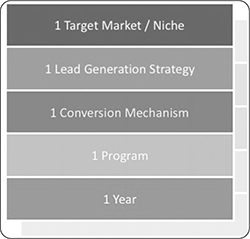
One of the significant breakthroughs in accelerating our growth was a concept called the “Rule of Five Ones.”
I learned this through Taki Moore of “Million Dollar Coach,” and I believe he got it from Clay Collins, the owner and founder of Lead Pages.
The core of this principle is that if you want to accelerate the time it takes you to get to seven figures, focus on simplifying what you do.
For a Seven Figure Agency, the Rule of Five Ones means:
Really what I want for you more than anything else is a business that can scale.
The roadmap for building a highly profitable Seven Figure Agency is built on three pillars of success:
Let’s drill into these in more detail.
This is how we generate leads, online and off, and get them to come to us pre-positioned to buy at premium rates and then hire us for our services.
This is how we package our service offering in a way that gets consistent, measurable results and returns on investment.
The key is to do it in a way that frees you up from doing custom work for each client and having to do it all yourself.
This is how we keep those clients with us month after month. If you can’t retain, you can’t grow, and you will be taking two steps forward and one step back.
Taken together, that’s the Seven Figure Agency model:
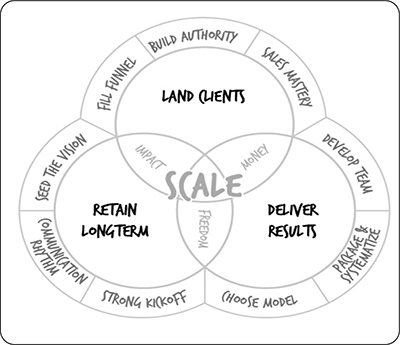
If you can get the three elements within each of these well-honed, you’ll have a business that grows, scales, and expands.
In this book, we’ll go deep on the last of these so you can ensure your growth on the back of successful long-term client relationships.
If we want to improve retention, we need to understand why clients decide to leave an agency.
People tend to believe it’s a variety of factors such as:
Clearly, clients are paying you a monthly retainer fee to generate results for their business.
So, if you can’t do what you promise to do in exchange for their dollars… whether that’s SEO, pay-per-click, Meta ads, or funnel creation, or something in-between… and you don’t give them a tangible, measurable return on investment, you have no right retaining their business.
It’s essential to have the results dialed in. If your results are poor, you could do many good things for them, but eventually, they will cancel.
However, I used to think it was just about the results.
I thought that if their phone was ringing and there was a return on investment, I would let that speak for me.
In the early days of our agency, we found the results were good, but the service was poor:
I didn’t want to meet with clients every single month. I didn’t want to jump through hoops and deal with all this other stuff.
But although we were giving them value for money, we were still losing too many clients.
Here’s the harsh reality:
So, while service and results are both important, there is something else we need to consider if we want to improve retention.
Clients will sign up with you because they believe you can generate leads and sales for them.
But that’s not the reason they decide whether to stay or leave.
Studies show that the number one reason that a client will leave your service is perceived indifference.
Check out the study here:

If they feel your company doesn’t care about their results anymore, that you’re not proactively thinking about their growth, that’s when they will be ready to move.
Yes, we want to give them better results and to communicate more effectively about what we are doing.
But the number one reason they’re going to leave is perceived indifference. We want to think about how we can ensure they never feel we don’t care.

To improve retention, we must get that balance right.
When we’ve got all of that dialed in, that’s where good, strong retention comes in.
If we can improve retention, that’s going to improve profitability.
We just need to understand that it’s neither just results nor service; it’s a combination of both.
The Retention Roadmap that I share in this book is designed to deliver that result. It does that based on our many years of experience plus the results of many successful Seven Figure Agency members.
You can make it easier to improve your client retention by following some core principles in the way you present and deliver your services.
As we go through the book, we will detail some specific steps you can take to improve your client retention.
By following these steps to increase your focus on keeping your clients, you will certainly make more money, improve your profitability, and grow your agency.
However, there are some core principles or fundamentals that apply to your agency that I believe will help you improve long-term client retention. These are:
Let’s look at each of these in more detail to see how you can apply them in your agency.
One of the core tenants of the Seven Figure Agency Model is to focus on One Niche. That approach has so many benefits and ramifications from being more attractive to prospects, making it easier to land clients, and simplifying delivery, but it also helps with retention. By being in a specific niche you are able to get really good at delivering results for that niche. You get to really understanding the industry & how it ticks. You get further intrenched in the associations & groups and all of that plays a roll in having a higher than average retention rate.
That means:
I think many agencies get stuck in this trap where they are looking for the latest cool, sexy thing to sell in digital marketing, such as:
However, if you focus on impact, delivering services that generate a return on investment, that will make you a lot stickier.
This reflects how you design the services you offer and how you present them to prospects and clients.
People will only pay so long for an activity-based service, whatever activity that is.
If you can frame your service offering so that they can see they’re going to spend $1 and get $3 or $5 or more in return, you have a strong foundation for a good service that will retain clients for many years.
The key issue here is ensuring the services you offer—and the way you present them—demonstrate to clients that you give them a strong return on their investment. Bottom line…don’t offer services just to check a box. Offer services that make it rain.
That may mean considering changing the services you offer or at least the way you communicate them.
The second fundamental is that you may benefit from broadening the range of services you offer to clients.
If you’re just doing Facebook ads or email automation or just selling SAAS, you only have one foot in the door.
Whereas, if you’re focused on impact and provide a more comprehensive solution that will get them what they want—which is more leads, more sales, and revenue growth—they will have more reasons to stick with you.
If you’ve got control of their website and, potentially, you’re doing SEO, you’re driving leads with database reactivation and email marketing, and you’re taking a holistic approach, that is going to improve retention.
One issue is that many agency owners who are just starting and doing one thing don’t realize that it is relatively easy to leverage one thing into another.
For example, if you are running ads for building a database, database reactivation is a natural extension. It might make sense to add that as an additional service.
Now, I’m not suggesting you need to become a full-service agency or a jack of all trades. Keep it simple.
You don’t want it to become too complicated to manage. But consider looking beyond what you currently offer.
If you continue to focus on impact, you don’t just add services for the sake of retention, you add services because they help you control the outcome the client gets. That’s clearly going to make your offer stickier.
The other big benefit to going wider with your service offering is that you can diversity the mechanism for results. If you just do SEO and the website doesn’t rank, your client will quickly grow frustrated and cancel. If you just do Google Ads & the cost per lead is out of control, the client will be upset & stop the campaign.
However, if you have a blended solution where you are able to count on results from SEO, Paid Search, Direct Traffic, Database Reactivation, Retargeting, etc., you have a synergistic / halo effect where they all work together for a better outcome for the client, and if for some reason the SEO isn’t pulling its weight that month you have those other services that might be performing great.
This is especially helpful while you’re getting a SEO campaign off the ground (it may take 3-6 months+ for the rankings to start to populate.) You can create some momentum with Paid Search & Database reactivation and once the SEO kicks in the entire campaign performance gets even better over time.
Bottom line, if you have more services that you handle for the client you can show better overall results for the client which will absolutely help with retention. It’s hard to consistently crush it with a single channel.
Think about whether you can expand beyond what you currently offer so that you can give the client more reasons to stay with you.
When I was seeking to improve retention in my own agency, I looked at agencies with high churn rates, where they were constantly losing clients.
One thing I noticed is that a key problem was often their client selection.
They had a great offer, and they provided excellent service and good results for their clients. But they were still losing clients month in and month out.
The big problem was often the type of clients they were working with.
For example, are you choosing to work with startups, one-man operations, or smaller companies that don’t have their business fully fleshed out?
Or are you focused on working with more established companies, which are already successful and are looking to accelerate things to the next level.
In our agency, working with plumbers, our churn rate was through the roof when we worked with one-man operations. There were constant cancellations. We were giving them the same high-quality services that we were giving other clients. But their outcome was totally different.
When we decided to change our focus to plumbing and HVAC companies greater than $1 million per year, the game changed. Those companies were better established. They had suitable systems in place, and they could manage to pay our fee and get a good return on investment from our services.
Now, I know many people would struggle to turn down a client ready to give you their credit card. But in the grand scheme of things, it could be wrong to say yes in some situations.
Everyone makes their own decisions about who to work with, but typically focusing on the higher end of the market will help you build the strongest foundation with your clients.
Perhaps changing your focus on the type of clients you choose to work with could help you improve your retention.
The next element that can have a significant impact on retention is how you set expectations at the start of a client relationship.
You could start by framing it like, “Hey, let’s do a test. Let’s see how things go the first 30 days. We’ll see where we are after that.”
In the client’s mind, even if they’ve signed it up, they’re thinking, “I’ll give this about two weeks, and, if it’s not crushing it for me, I’m out.” That is a recipe for disaster & astronomical a cancelation rate.
The alternative approach is, “This is going to be a long-term business relationship. This is what we’re going to do. These are the results you can expect. But if we’re not going to commit to doing this together for the next 12 months, let’s not bother.”
Naturally, the “30-Day Trial” type of approach seems easier to sell on the front end. However, the chances are they’re going to stick around longer if you frame it for the longer term right from the start.
You don’t have to sell it as some iron-clad 12-month contract. The key is to frame it using the language of a relationship. “This is what’s going to happen over the first three months. This is what’s going to happen within the first six months. This is what will happen by the end of the year.”
When we made the move from “Month-to-Month” to “12 Month Agreements” we saw a major increase in our retention rate & it didn’t impact our ability to close clients on the front end as much as I was expecting.
With those fundamentals in place, let’s look at the roadmap for improved retention.
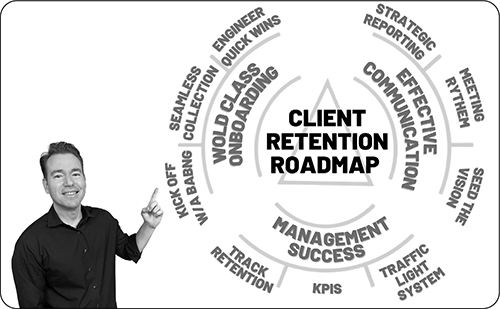
The Client Retention Roadmap is a series of steps that will help you ensure that clients stay for longer.
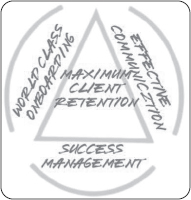
This covers three different elements or phases that we need to address.
The three phases are as follows:
We’ll go into these in more detail in the following chapters but let’s start with the big picture.
At the start of the process, the client has given us their credit card and placed their faith in us. What happens in the first 24 hours & week will have a major influence on whether they are still with us 12 months down the road.
That’s why we need a carefully designed, World-Class Onboarding Experience.
We need to do practical things like make it as easy as possible for them to give us the data we need such as usernames, passwords, and images.
While it can often take some time for clients to see a full return on their investment, there are some steps we can take in the first couple of weeks to generate some quick wins.
When the onboarding experience makes them feel comfortable right from the start, that can go a long way to improving retention.
The second phase of the roadmap is Effective Communication. We want to think about how we are reporting to them about what we are doing and the results they are getting.
That includes thinking about what we are measuring and what type of reports we are sending them.
We also need a clear plan on how and when we are going to meet with them to keep them informed without making them feel overwhelmed.
A key part of this is seeding the vision about how things will look in the future so that they feel part of a long-term relationship.
The next phase is what we call Client Success Management.
This is the business side of client retention, which covers how we manage the agency & our account management team internally to ensure the best possible client retention.
The first element of this is that we will only improve what we measure. So, we need to ensure we are using the right measures for retention and tracking it accurately.
A key part of that is having the appropriate Key Performance Indicators (KPIs).
One of the important issues that will affect retention is that, as you scale, it’s not just you that is managing the relationships. If you want to have some freedom, you need account managers in place. To make that work, you need to recruit well and have good training and systems in place.
The final part of a strong success management process is that you need to have the right systems and processes to identify clients who may be about to cancel and to take appropriate action.
That’s how we can grow and scale our operation while still maintaining high-quality client retention. That’s what we’ll cover next.
Creating a World-Class Onboarding Experience
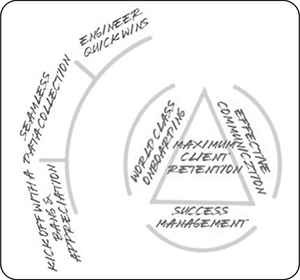
What happens immediately days after someone signs up for a retainer-based relationship will have a significant impact on whether they are still a client 12 months down the road.
We need to put in place several elements to make the first few weeks and months of the relationship as impressive as possible. The three key elements of this are:
In the following pages, we’ll look more closely at each of them.
One of the keys to world-class onboarding is making sure you come out of the gates strong. We want to welcome new clients with a bang and appreciation.
They have just signed up to pay a substantial retainer fee. It could be $1,000 to $5,000 monthly (or more.)
What you do next will have a big influence on whether they are still with you 12 months from now.
Almost every agency will have them fill out a credit card authorization form and they’ve got an email that goes out with an onboarding form. Some will have a launch call after that.
You need to do more if you want to stand out, such as:
You can have a custom box built that you can send in the mail to say, “Welcome aboard. You’ve made the right choice. You’re in great hands.”
I want to encourage you to bake that into your process—something to show appreciation within the first week that they get physically in the mail.


A welcome basket with goodies inside has an entirely different impact than a digital gift card. Very rarely today do we receive things physically in the mail, and it goes an incredibly long way. So. think about adding that to the process.
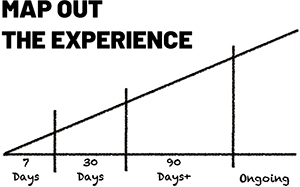
The first step is you want to map out in detail what the experience of that first week looks like for them.
After you have mapped out the first week, do the same for the first 30 days and the first 90 days.
Think about all the touchpoints and the communication. Think about what that experience feels like for them.
In Michael Gerber’s excellent book “The E-Myth Revisited” there’s a story where he talks about a hotel operator who had choreographed an experience where when you walk in, they call you by your name, and then, when you go to your room, they’ve got it all set up the way you want it.
The owner of that hotel spent much time thinking through every single step of not just their process but the experience from the customer’s point of view.
I want to encourage you to get intentional about what the experience feels like for your clients.
At the end of this segment, I’ve shared some of the key elements we include in those first 90 days. I want you to design your own system based on what is right for you. But I hope that will act as a useful guide.
Some of us have excellent onboarding processes. We’ve got these long checklists, either in ClickUp, Asana, or Monday, or something like that. When we land the client, we get access and go to work.
But sometimes, when we go to work, if we’re not checking in with the client and telling them, “We just did this. We just did that. Here’s something we updated,” they feel like you just went radio silent.
They’re incredibly likely to lose confidence and cancel if they get that feeling, especially in the first 30 to 60 days.
So, think about the little things that you do for your clients. Let’s say you set up a call tracking number or set up a landing page, or you ordered some content for their website. There’s no reason you can’t send that to them and let them know along the way.
When you do that, you go from ghosting them almost to where they feel like you are over-communicating. It’s a little obnoxious. “I’m excited about this guy/girl, but their team is sending me so much stuff.”
I’d prefer to see you on that side of the spectrum than where they think you went radio silent on them.
There are certain things we can do through automation. Certain items require a manual email or require a personal call.
So, you want to make sure that your team is communicating as new things are set up for the client.
However, don’t hide behind the automation. Don’t hide behind technology; pick up the phone, get on Zoom, and have honest conversations.
I promise you this will help create a world-class onboarding experience that sets the tone out of the gates with the clients.
The next consideration is that we want to make it as easy and seamless as possible to collect the data from the client. Normally there is quite a lot of information we need. It includes details like:
There’s only a handful of ways that we can get that. We can send them a Google document, we can get on the phone with them live, or send them a web form to fill out. You want to make it as easy as possible for them to pass over that information so that you get everything your team needs to hit the ground running.
You don’t want them to feel like they’re spending two hours filling out a cumbersome form or that they’re jumping through bunch of hoops. I recommend doing this as a simple multi-step form, followed by a live meeting / conversation.
Consider whether you can create a new form or a new approach to make this easier for the client and more efficient for you.
The big mistake many agencies make is that they just want to send the form and leave it to the client. There should be a combination of the two. We want to take the weight off their shoulders and let our team take it on.
Next, we want to engineer quick wins. By this, I mean we want to be intentional about getting our new client some tangible result (leads, sales, activity) as quickly as possible.
We want to get them something tangible within the first couple of weeks.
Whatever your focus is… whether it is Facebook ads, SEO, or website development… think about how you can give them a tangible win in the first couple of weeks.
My agency was mainly an SEO company for many years. Our whole play was building and optimizing websites and getting them ranked so they would start to generate leads and phone calls.
The problem was that sometimes the site got ranked on maps and the client got a call or two in the first couple of weeks. And that was great. But other times, it could take months.
Of course, any client getting three, four, or five months in, without some tangible, measurable result, will start to question what they’re paying for.
If you’re in a place where you’re waiting 60 to 90 days, you need to be planting seeds that are going to generate results eventually.
But in the meantime, that’s going to expose you to lots of churn. So, if possible, you should engineer how you’re going to get a lead or two within the first couple of weeks and set specific things up that they get to see, feel and touch early.
If you can engineer a process where they see some activity, they’re excited, they see what’s happening and they start to see results, then they’re more likely to stick around for the long term.
There are certain things we can do in the first couple of weeks to generate some wins that will help get us out of the onboarding process and into the ongoing relationship.
It’s important to map out the first few days and weeks of communication after someone signs up with your agency.
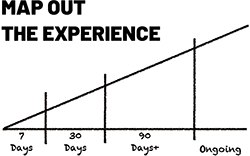
Think about what you want to integrate into your initial seven days, 30 days, and 90 days.
Think about the touchpoints and the communication and map this out step-by-step.
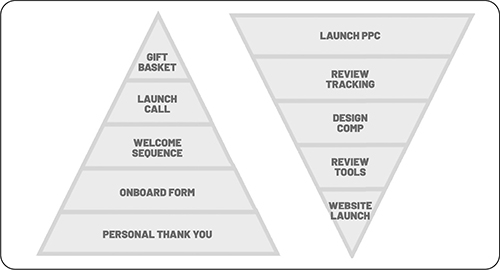
Here I’ve given you a high-level overview of some of our communication flow and what the process looks like. You can adapt these for your own use.
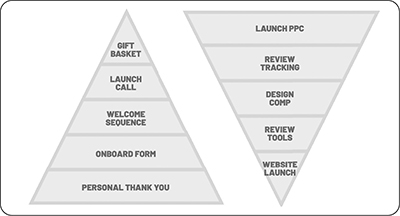
Let’s look at each of them in more detail.
One of the easiest but most powerful steps you can take quickly is to send a personal thank you message.
They signed up and they gave you their credit card details. Now, you should send them an authentic personal message.
This could be:
It’s just a quick message to say, “I saw you just came on board. Thanks so much. We’re excited about working with you.”
We want that to happen almost instantaneously.
This is more significant if you’ve had a salesperson involved, and it feels like the owner is now reaching out to them personally.
Even if you sold the account personally, a quick welcome message saying you’re excited to have them on board is a good play.
I will usually also have my team reach out to them on social media—as me—with a quick personal message, “Welcome aboard. I’m super excited about working with you.”
The point I want to hammer home is don’t just use email. People are more apt to see a text message, Facebook message, or LinkedIn message than an email.
They’re expecting an automatic email. They would not be expecting a more personal message to come from you as the owner.
On the following page, just as a point of reference, I’ve included an example of the personal message that goes out from me welcoming new people and thanking them for their business.
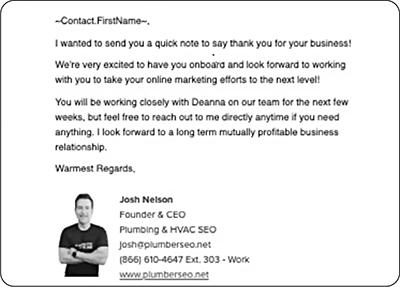
I also like to record a personal welcome message from my phone & sent that to them via Facebook Messenger. In that video I mention them & their company by name, so they know it was recorded for them personally.
This also opens the dialog for 1:1 communication as needed.

The next step is we want to get an onboard form in their hands.
It lets them know the information you’re going to need from them and tells them the process you use.
You want to get that into their hands, usually within the first 15 minutes, leveraging some type of automation. You may have this in HighLevel, ClickUp, or some other mechanism.
This is what the onboard form that we use looks like. There’s a video, “Welcome aboard. We’re so excited. Here’s what we’re going to do.”
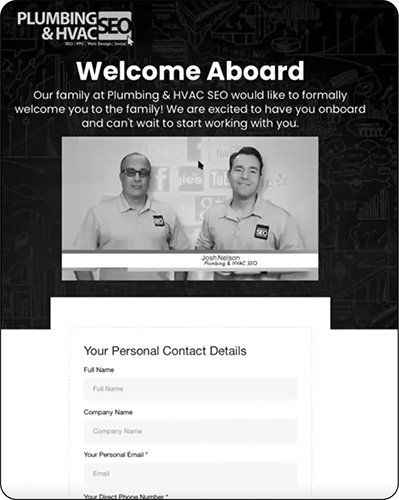
We ask them to fill out this onboard form. You can’t see the whole thing here, but it is a multi-step form. It captures little pieces of information along the way.
We do this in HighLevel, but you could use various survey platforms to do something similar.
You just want to make sure that you’re making it easy to capture those details.
Several automated steps are triggered once the form is filled out. For example, it generates a confirmation to send a welcome box. All kinds of nifty little triggers happen.
Once the form is submitted, it allows them to schedule their onboard call if it’s not already booked.
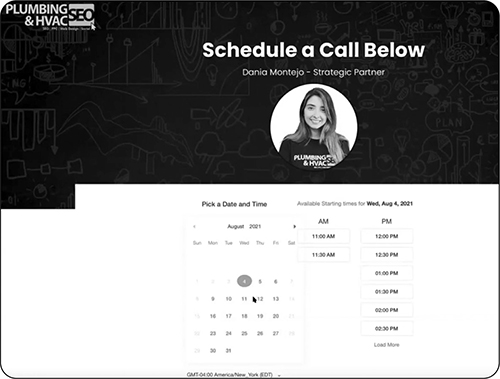
We’ve got a page like this for each one of our account managers where they can pick a time and get that scheduled.
After the initial messages, you should set up a welcome sequence to keep them informed about what is happening in the process.
Some of this will need to have manual touches but you can also have some type of automation running in tandem where they’re hearing from you every couple of days. You don’t need to personally write each email and reach out to them.
I find that many agencies are happy to leverage automation heavily in their sales process, such as for scheduling appointments, reminding about appointments, and inviting people to events. Surprisingly, though, they are often uncomfortable about leveraging that same level of automation for communication with their client base. There’s no reason not to use automation in this way.
If you think about it, you could design a sequence of 30 days’ worth of non-intrusive automated messages covering topics such as:
You could just draw up a sequence for that type of communication. Your new client then feels like you’ve got all these touches going in addition to what you or your team are doing manually.
If you do that, they really can’t help but feel like you’re on top of the ball.
In our case, the onboard form above also triggers the new client welcome sequence, which is a series of emails.
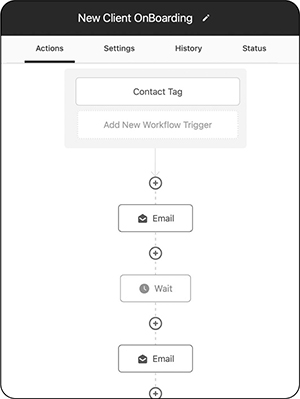
For example, it includes:
These are spaced out every two or three days or so. It just covers information you would typically provide or ask for anyway, but it gives you the ability to dial that out in advance.
You can set up a sequence like this in HighLevel.
What’s valuable is that we can mix it up between email, text messages, and tasks that must be done by the team.
We also send out a custom-designed welcome box with various items, the kind of thing you would potentially give out at a trade show, a t-shirt, and a little binder.
We invest about $75 in this box, and we get it shipped out.

If you think about it, they’ve signed up, they’ve met their account manager, they’ve gotten this onboard form with a video on it that’s very professional, then they get this custom branded box in the second week.
It just creates this professional experience like, “Wow! I have not seen any other agency do this.”
As part of this process, you should have a formal launch call. This could be done over Zoom.
It includes things like gathering the usernames, passwords and other information and resources we need.
But it’s also getting to know them, setting the expectations, reselling the experience, keeping them informed about what is happening and seeding where we’re going with the relationship.
This is a conversation that our account manager has, and we want to have a well-thought-out process.
We have created a document that we use as a guide for this which we call our New Client Launch Call Checklist. It’s about eight pages and it outlines the key information we need to gather.
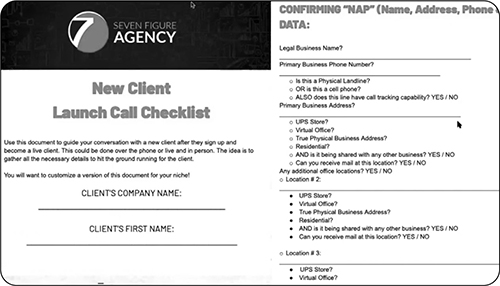
They will submit some of this information through the onboarding form. However, people can get stuck in parts of it. This can apply especially to information about their domain or access to something like Google Business Profile.
If you don’t hop on the phone with them to help troubleshoot that, the whole process can be delayed by weeks or even months.
You want to troubleshoot as much as possible in this initial conversation so that the client isn’t going to be delayed getting information to you.
The role of the account management team here is to explain what is required and why it is needed to help speed up the process.
We can tighten up long-term expectations if we engineer all of that into our launch process.
While this helps the efficiency, it also impresses the client because few companies have taken the time to plan a thoughtful and meaningful onboarding process in this way.
In this step, we are moving from the launch process and going into the ongoing account management.
The salesperson has handled the selling part. Then, in our agency, the new client launch coordinator manages the launch process.
The launch process is the most tedious. It has the most things going on, usernames, passwords, understanding their business, getting their websites set up, getting their campaign set up, and making sure they understand tracking.
Then they go from that launch coordinator to the account manager, who will meet with them monthly, go through the reports, and keep them on board.

We found that sometimes there was a slight disconnect in that transition. They were happy with their sales guy, then they went to a launch coordinator, and now they’re with an account manager.
To smooth this process, we created a little custom coffee box that we send out. Ours is unique to South Miami; it’s got Cuban coffee.
The message is, “Hey, I’m Johnny, your new account manager. I’m excited about working with you. I wanted to send you this gift.”
Another important step that we have in the first week is that we drop off a gift basket.
We order from a service called Gourmet Gift Baskets. We usually spend about $75 every time a new client comes on, and they get a lovely gift basket with cookies and crackers.

The message is, “Welcome aboard. We’re so excited you decided to do business with us. It’s going to be awesome.”
We like food as it’s something that can be shared between different members of the team and can help build bonds.
I’m sure you’d be impressed if you signed up for an agency that dropped the welcome basket and had this welcome sequence and this excellent onboarding process.
You’d feel, “We’re in good hands. This company pays attention to the details, and I’m confident we’re in the right place.”
These may seem like minor elements but putting these minor elements in place will improve your long-term retention.
During the first week we also want to create an experience at their end that starts to demonstrate some results.
The exact form this takes will depend on what we are doing for them.
Let’s say we’re doing an SEO strategy. We’re building out their website and we’re trying to get them ranked organically. This can take time so, ideally, we want to do something right away to get the phone ringing.
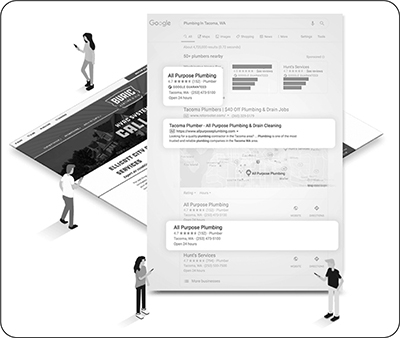
We used to wait until the website was done and everything was finished before we did pay-per-click.
Of course, that leads to a massive delay in getting leads and calls.
So, we started to set up some simple landing pages and a very basic pay-per-click campaign as quickly as possible. That way we could start to drive some traffic and some calls.
If we can get them a lead within the first week or two, they’re starting to feel, “This is great. I see the fruits of their efforts.”
So, whether it’s launching a pay-per-click campaign, turning on their Meta ads, or doing a database reactivation campaign, we want to do something to engineer a win within the first two weeks.
There are certain tools that we like to set up during the early stages that deliver unexpected value to new clients.
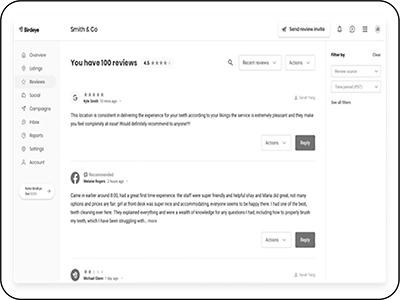
For example, we set up review tracking for them using a tool called Birdeye.
We don’t just set it up. We set it up and let them know that we have done so.
We explain, “We set you up on this. It’s a full tracking of all the online reviews you have going forward. You will get an alert every time someone writes a negative review. We’re going to catch that and help you troubleshoot it and respond.”
It’s not a financial win, but it’s an outcome they get excited about.
So, think about those types of things that you can implement for your clients.
Don’t just go set up the username and password and activate it. Think about how you can make an experience out of it, so clients feel its impact and they know that you did it for them.
By the time the second week is over, we’re building a new website for the client.
We want to have the design comp in their hands. That’s the design of the homepage and the internal page for their approval.
Again, a lot of this came from trial and error. We would just build the website on the fly for a long time. We’d get into WordPress and start building.
Sometimes it was good. Other times, they didn’t like the site. They were upset that it didn’t look the way they expected. They had different expectations in their mind.
So, we moved to just designing a PSD comp, showing it to them, and getting the approval. Then building off that helped us with some of the rebuild redesign work that we had to do.

We reviewed some of the tools we set clients up on. For example, how we set them up on call tracking. We set them up on a lot of different things: HighLevel, NearbyNow, BirdEye, etc.
We have a special meeting with them to review the tools we’re setting up to understand why they’re there and how they interact with them.
It’s another piece of communication, and they are like, “Wow. Within the first couple of weeks, I see a lot of activity coming from this agency. I feel good about where things are headed.”
Then, probably within the first six to eight weeks, our new site will be launched. Then, of course, its optimization and ranking and everything else.

If you follow these steps & implement the ideas outlined here, you’ll have an amazing onboarding experience that wows your clients out of the gates and sets the foundation for a great, long-term client relationship.
Effective Ongoing Communication
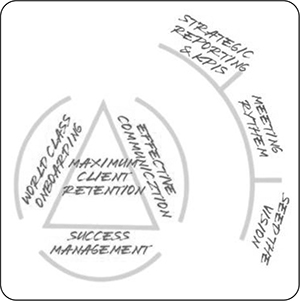
Building on your world-class onboarding process, the next stage of your roadmap to better retention is effective ongoing communication with your clients.
There are many different aspects to communication, and we split it into three main categories.
We’ll drill into each of those in more detail.
The first important element of communication is how we report to clients what we are doing for them and the results that our work is delivering.
This is about strategic reporting and Key Performance Indicators (KPIs).
There are lots of things we can report, such as:
The risk here is that we drown the client in numbers by giving them too much information. That could lead them to end up being confused and uncertain about what we are doing for them.
You want to think about the following:
In many cases, LESS of the right kind of reporting gives you MORE effective results both in how the client feels about you and in your retention rate.
Sell The Holes, Not The Drill
The best approach is to strip out all the excess and get to the nuts and bolts of what the client wants, which is:
We want to figure out how to get our reporting dialed in so that the client knows without a doubt in their mind, “I’m spending money, but I’m getting a return on investment. These guys are doing a good job for us.”
I used to meet with clients every month, and I would go over their analytics. I would have a 17-page keyword report that showed the rankings for everything. I’d have a list of all the activities, links and the blog posts.
The truth is, they didn’t care.
They are paying us to take responsibility for certain things. So, they want us to get on with it.
Of course, some of them do want to get into the details, or at least have access to the details.
But for the most part, they just want to know how much they spent, how many leads they generated and whether they got a return on investment.
If there’s a return on investment, they want to keep going. If there’s not, they want to know what you are doing to change it so that they are on the right track.
This is what our report looks like today. We use NinjaCat for this, but you could do something similar in Google Data Studio or Agency Analytics.
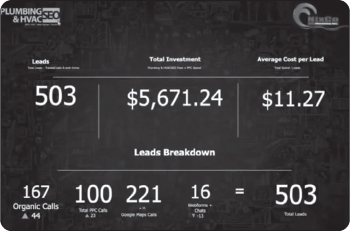
We went from drowning the client in numbers to answering their most important questions:
This is for Nixco Plumbing in Mason, Ohio. It’s a slam dunk, and he’s super happy.
When you show your clients metrics like this, it gives them what they really want.
Yes, you should be doing work, and you should have activity. You should be able to show them what you’re doing.
But the bottom line is that what they want is the outcomes.
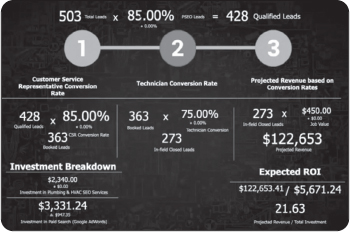
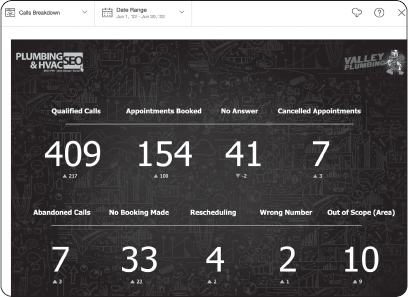
This is the second part of our monthly report which gets into Return on Investment (ROI) projections. They average about 500 leads in any given month and what we do is help them quantify the projected return on investment based on the conversion rate at each stage of the process.
With this information, you feel pretty good about the money you spent, your results, and where we’re headed next with the business relationship.
Now, I understand this format doesn’t work for all of us because we’re all in different verticals and niches, but the concept of simplifying it and getting it to the critical facts they want to know—how much did I spend and how many leads did I generate?—can have massive ramifications in terms of your retention rates.
So, for me, strategic reporting means we’re going to lead with the key performance indicators, which are what those leads are and the results.
But we also want to have the data as well:
But we don’t have to cover that with them every month.
We don’t need that to go to them automatically in a monthly report. We should just have it if they decide they want to dive into the details and look at it more closely.
We have a report that goes out automatically on the ninth of every month. Then the client account manager checks in, “I want to jump on a call and review the report with you, answer your questions and let you know what we’re up to next.”
We know what the rest of the data is, but this is the critical information they see, showing them that they’re getting a good return on investment.
Most of us know how to do digital marketing. We know how to make it rain for the client. We know how to generate consistent, measurable results. The key is that we must:
Explaining the data and the results is important. But the reality is that results alone don’t ensure retention.
We know that we can have good results, but clients will still leave if the service isn’t up to par.
That’s why the regular meetings that we plan with clients are so important.
This is what we call it the MEETING RHYTHM:
The fact is some agencies don’t meet with the clients at all. They go radio silent. Their view is, “We’re going to do our work. The calls are going to go to them. The leads are going to go to them. Hopefully, it’s all working out on the other side.” “No news is good news.”
And then the client cancels.
So, we want to think about what that meeting ritual and meeting process should look like and have that built into our agency.
In most cases, we want to aim for at least one monthly review with the client every month.
If you’re charging less than $1,000, maybe it’s different. But if you’re $1,000 or more, just make it a benchmark that you or somebody on your team is trying to meet with them to review the report, talk about the outcomes, and seed the vision for the next 60 to 90 days.
If I look across our database of Seven Figure Agency members and the ones growing consistently, the ones that have the best retention, this is what they do.
They don’t try and hide behind email automation. They don’t hope that no news from the client is good news.
Thinking that if the client’s not reaching out, and they didn’t ask for a meeting, that you don’t need to meet with them, is a recipe for failure. I can speak about that because I tried it.
Just be intentional about it. You must commit to doing it.
The best way to organize these meetings is typically via a Zoom-type session so they can see your screen. You can have a meaningful conversation, and you can see each other.
It’s important to ensure these meetings are structured so that they cover everything required.
When you do that, you’re going to review the progress. You’re going to review the rankings. You’re going to review the analytics.
If they want to, you can maybe review some of the calls.
Discuss what you need from them, homework that you need from them. You should put some tasks into their court.
Then, most importantly, you outline the game plan for the next stage:
That format works. You show up; you meet with them and go through the data. They feel good. They see what’s happening. And the relationship continues.
So, you want to have an engineered monthly review call that either you or your team follows up on.
Eventually, you want to build an account management team to do these calls for you.
You want to structure the review call with an agenda, process, questions, and the things that you cover in sequential order that you can train your team to follow to create a consistent experience.
At the end of this chapter, I’ve included a step-by-step guide showing the ideal way to run these meetings.
Now, it’s not lost on me that not every client wants to meet every month.
Sometimes the client doesn’t answer your phone call, doesn’t respond to the request for a meeting, or just doesn’t show up.
For a long time, our team would say, “I reached out for the meeting. Nobody responded. It’s on them. I guess they don’t want to meet.” And we’d just call it a day.
Then six months in, the client reaches out to us out of the blue, “Hey, we’re canceling.”
We’re like, “What happened?” and they say, “Well, we haven’t heard from you for a long time, so we’ve decided to go a different direction.”
No news isn’t good news. So, using an excuse that they didn’t reach out for the meeting isn’t an option.
I would encourage you to plan to meet with every client. Touch them at least three to four times via email or text message, “Hey, I just want to go through the reports & plan for the next 90 days.”
Then have a backup plan: “We didn’t get a chance to meet this month. I know you’re busy. I wanted to shoot a quick video outlining some of the key outcomes and what we will be working on next.”
You can just make a Loom video. It’s not as good as a live meeting, but at least you’ve got a tracked interaction.
If you’ve got an account management team, you know that the account manager did some due diligence.
The last thing you want to find is that the client didn’t meet, and nobody looked at their account. So, maybe something fell through the cracks, or perhaps something dropped.
If you make it part of your process for you personally or your account managers to send a recap every month, the client can’t feel indifferent because you reached out, even though they ignored you.
Your account manager can’t drop balls because they have a commitment to do something. They have to record a video at least.
Then you’ve also got a trail of communication. When you send an email, when you shoot a video, when they watch it, all of that is trackable inside HighLevel or whatever client management system you use.
So, you can go back and say, “Well, we reached out to you four times for the appointment. We sent you this recap. We feel good about what we did on our end in communicating the results and the outcome.”
As I said earlier, the number one reason clients leave you is perceived indifference.
Even if you know them, care about them, and want them to win, if they feel like you don’t care, that’s the number one reason they’re going to leave.
So, while we want to ensure this communication process lets them know about the results and about any action they need to take, we also want to make them feel loved, to feel pursued.
A key part of that is that we want to seed the vision.
Outside of perceived indifference, clients leave a long-term business relationship because they don’t see where you will take them next.
Remember, they leave because they start to feel like the grass is greener or that they’ve gone as far as possible with your company.
This happened to us a lot in our agency. The clients would sign up. We would do our thing. They would start to get results. They’d be happy.
In the review calls we were just reviewing last month, “Last month you had this many calls and this amount of ROI.”
There was no discussion that, “You told me your goal is to go to 600 calls, so this is what we’re going to do next. This is what we’re working on.”
But in digital marketing, there’s tons of competition. Everybody and their mother wants to sell them the next best internet marketing strategy.
So, they’ll look at you and ask, “Okay, what’s next?”
And you’re like, “Well, I built the website, and I did the thing, and now you’re getting all these leads. Let’s just let it run.”
When you get to that place with the client, they feel like their vision has surpassed your vision for them as a client.
So, you must always be seeding the vision in these meetings with clients, “Here’s where we’re at. Here’s what we’ve accomplished and what’s coming next.”
You want to train that into your account management process, which we’ll discuss in the next segment. There should always be some new thing that you’re bringing to the table. That is why yes, the results are there, but they have more reasons to stay with you long-term.
In this segment, I’ll go through the ideal monthly review call step-by-step.
As I said earlier, you want to aim to have these meetings monthly if possible and try to get them scheduled out in advance.
Having a clear agenda for the call looks highly professional to the client and is also much easier for you.
We recommend conducting the calls online using a service like Zoom, Google Meet or Microsoft Teams.
I’ll run through the key elements of the call in the following steps.
In each of the steps, we have provided some suggested scripting to give an idea. You’ll naturally have to adapt this to your specific circumstances.
Before the calls starts, you want to prepare all the necessary material in advance and have the tabs you need open in your browser ready to share the screen as appropriate.
You should also think about the key messages you want to get across to the client in addition to the detailed reporting, such as:
The exact elements you will need to have open in your browser depends on the processes you use. We generally have the following prepared and open:
As with the overall relationship, the success of the call will depend greatly on how you start it. The key is to demonstrate that you have everything prepared but that you want their input and feedback.
Thank the client for taking the time to do the call.
You may have to take them through this step-by-step. “Please open your computer browser and go to the meeting link I just emailed you. Let me know when you’re there. Click “Join” and allow your browser to connect. You should be seeing my screen now. Do you see it? I have your website up.”
Now we get into the detail of the meeting, where we go through various aspects of the analytics:
Great I wanted to point out a few things & discuss some things we’ll be working on this month
I noticed a few things that we need to put some focus on
Finally, you want to wrap up the call on a positive note, with clarity on next steps while ensuring you have covered everything necessary.
When a client gives you work that needs to be done by the team or you identify issues that need to be addressed…
Once the ticket is complete, double check to be sure & then send an email or call the client to let them know and close the loop.
If you followed the steps outlined in this section, there is NO way your client can feel perceived indifference because you’ll be connecting with them several times throughout the month & communicating with them in a meaningful way. They will understand the value of the services you are bringing to the table & be aligned with your vision and how you will continue to help move them toward their goals & continued growth.
Client Success Management
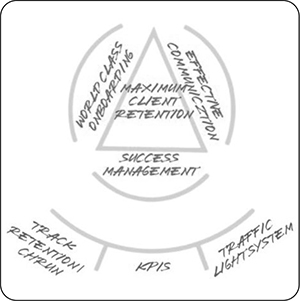
As your agency grows, retention can become even more challenging because you need to manage the success you are creating.
A great onboarding experience and effective communication can go a long way in helping clients see how you work with them and create value.
But we now need to think about success management. This is the business side of client retention and how we manage the relationship.
The three elements to this are:
Let’s look at each in more detail.
When you are delivering a world-class onboarding experience and communicating effectively, it takes a great deal of time and energy for every single client.
You are going through that process, collecting their usernames and passwords, entering everything into the system, and kicking it off inside your project management system.
If you’re the front line for all that communication with your clients, you will get bottlenecked, and balls will get dropped within the business.
The balls could potentially get dropped in terms of what you’re supposed to do for the client, which creates a bad experience. But you could also start dropping balls on yourself.
This is a real situation that every agency faces at some point in their growth, probably somewhere in that $30,000 to $50,000 range (15-30 clients.)
When you’re landing clients, you have to decide how to spend the time and how to spend your energy.
Start dropping balls on clients in the launch process, the monthly review process, or seeding the vision of where you’re heading within this business relationship, and clients will get frustrated. They will ultimately cancel.
You wind up with a “something’s got to give” scenario. You deal with the fact that this is where your business is and that’s as far as you’re going to go, or you’ll end up failing your clients.
Many agency owners have met with this decision you have to make.
It’s like, “I can’t continue to grow because I don’t have the energy. I don’t have the time. I can’t continue to keep up with the business development work that I need to do.”
If you can’t solve this, you’re going to lose confidence, and your ability to grow efficiently will suffer. The challenge you face at this stage in the game is:
The fact is that you’re not going to be able to do everything yourself. You need to put account management in place as quickly as possible. So, we’re going to talk about that.
In our agency, the first thing I removed myself from was operations.
I removed myself from any work related to:
If you don’t take that off your plate, that will quickly suck you dry and prevent you from growing and prevent you from scaling.
If you’re still clicking the buttons, you must offload that as quickly as possible.
As you get to about 10 to 20 clients, the second thing that starts to take a lot of your time and attention is the client interaction.
There are things we must do to engage and retain our client base. But if that’s all on you at a certain level, that will burn you out.
If you want to grow your business, if you’re going to go to seven figures, you must be doing many things:
If you’re trying to do all that while still trying to fulfill at some level & manage the clients, you will cap out.
When you get to 30 or so clients, you will not continue to grow, or your retention will suffer significantly if you don’t remove yourself from account management. You can’t do it yourself.
So, the second thing I removed myself from that bottlenecked me in the business was account management.
The good news is that, when you put in place an account management team to deal with the day-to-day management and the communication with your clients, you’ll find that it frees you up from some of the significant everyday challenges in running your agency.
We’ll talk about how you remove yourself from that process to create an even better experience for your clients, improve your client retention rates, freeing you up to focus on what you do best.
When you add an account manager that knows what they’re doing, has the right personality profile, is trained, and is being managed on the correct KPIs, you get relieved.
One of the most empowering feelings in your business is when you realize, “Holy moly, I can get a client, and I don’t have to do the onboard call. I don’t have to be the front line of communication with that client.”
If you haven’t experienced it, I promise you this will be one of the most relieving feelings in the growth and evolution of your business.
The other thing is that the clients get taken even better care of than before. And they stay longer.
Because, as great as you are, you don’t have the bandwidth to do it all by yourself.
As the business owner, I found that you can usually serve about 10 to 15 accounts well if you are closely involved.
Beyond that, you need to hire one or more account managers.
You want to plan to place a new account manager for every 20 clients you get.
Their job is to manage that relationship. Their job is to be Johnny on the spot and be available for the questions, to let the clients know what’s going on, or go through the reports.
And most importantly, you’ll be able to focus on what the entrepreneur and the business need to focus on: growth, business development, and thinking about where the company is headed next.
What success looks like to my mind, if you unpack what we’re going to cover here, is that the correct account manager or team of account managers help you serve your clients and get them great results in the short and long-term. At the same time, you can continue to focus on the growth within your business.
You need to plan to have that person recruited and trained so that nobody on your team is feeling overwhelmed and stressed out.
The account manager is like the QB. They’re the direct point of contact with the client.
They’re talking with the client, reviewing the reports, and getting requests for things the clients want to have done. They are communicating back to our team what is needed.
They don’t do the work. They manage the relationship. In our world, that’s what I mean by account manager.
We have a sales team that sells to new clients. Account managers focus daily on retaining the client base. I know that some agencies structure things a little differently.
At this point, I have hired about 15 account managers, employed, trained, ramped up account management teams, and hired and trained account management leadership.
Based on that experience, I will share the process you need to follow to attract, recruit, reward, and motivate the best account managers. These are some of the keys to unpacking the account management position and getting somebody to take over this aspect of the business.
To hire for the position:
I will go through that process in some detail at the end of this chapter.
One of the keys to account management excellence is that you can’t improve what you don’t measure.
The two key things we need to measure are:
When I ask most digital marketing agencies about their retention, they have no idea.
That’s not good enough. You must know what the formula is. You must have a simple tracking mechanism for it. You must be looking at it monthly and quarterly and know without question where your retention is.
So, first, you want to track your retention and churn rates. You need to put the right metrics and systems in place for measuring how well you are doing.
You must measure what your retention rates are, and there’s a formula for this based on:
We are interested in the number of customers remaining at the end of the period without counting the number of new customers acquired.
That means the customers remaining would be E—N.
To calculate the percentage, we divide that number by the total number of customers at the start and multiply by 100.
This gives us the following formula
Now, I know that can be a bit confusing. So, we have what we call a sales retention tracking sheet. This is a mechanism we put in place to plot out where are we at right now:
It’s got the formula baked right into it.
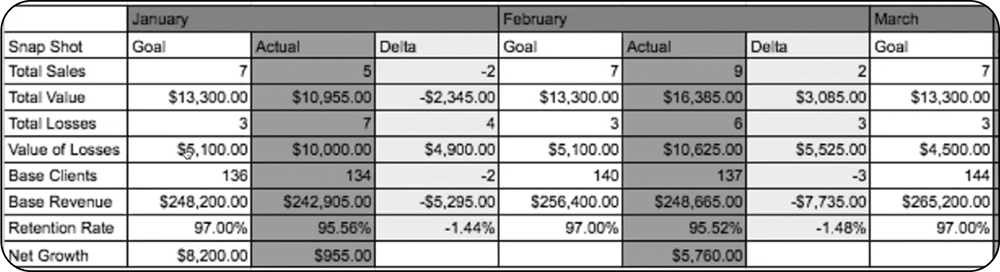
If you would like a copy of this worksheet, you can download it at the following link:
www.sevenfigureagency.com/tracking

I’m giving this to you as a gift that you can use. It has powerful ramifications from a growth perspective, like getting clear on how many clients you need to land per month at a certain retainer fee to get to seven figures or to get to whatever your goal is.
But it also is powerful for tracking your movement as an agency and tracking the monthly retention rate so you can grow that.
I’m often asked what a reasonable retention rate is and what you should shoot for, so you know if you’re on track or off track.
Looking at the spectrum of hundreds of Seven Figure Agency members, I’d say you want to be shooting for a 97% plus retention rate monthly.
You’re doing well if you can get to that 97% plus retention rate.
There are outliers where I know people who retain at 99% plus, which is fantastic. But 97% on a monthly retainer service at $1,000 or more is a significant number.
Above 95% is still pretty good.
We fell to about 93% retention several years and it was painful. I was tracking and was like, “Man, what are we doing here?”
That’s when many of these retention strategies I am sharing in this book were built.
We realized we were not communicating with the clients enough and that we did not have a great process for that.
We were not onboarding effectively and setting proper expectations. So, we created the welcome box and everything else.
As a result, we went from 93% to where now we’re averaging about 98% monthly retention rate.
So, here are some rules of thumb:
Second, we want to have some simple KPIs—Key Performance Indicators on our end we can look at like.
What are a couple of metrics you can look at for your client base to say, “Are we on track or off track?”
Building on the measurements we have now, we need a way to get advance warning of potential problems that can affect retention.
When you get past 50 clients, it’s hard to keep track of:
We need to put a mechanism in place to keep a bird’s-eye pulse on things, so we get ahead of the issues.
When that client writes in and says, “Hey, things are bad,” or “Hey, I’m not getting results,” or they write in asking for their usernames and passwords, you should be able to detect those as outcomes in advance.
You can then prioritize them and get to work and move those clients back into a happy place.
You can prioritize the clients who are most in need and make sure that consistent action is taking place to address their issues.
I encourage you to consider rating your clients in color-coded categories based on their risk of leaving.
You can do this visually using HighLevel, ClickUp, Airtable, or something similar.
When we moved to this, it helped me, as the owner, get a much clearer view of our client base.
Without having it on a board-based system like this, I couldn’t tell what was going on, who was happy and who was unhappy. It was like, “I hope we’re doing well enough.”
When we started to get intentional in this way and have it visible, we were able to take meaningful action every single week that tightened up our retention.
Here are the categories we use:

If you look at this on a kanban-board type system, you’d be able to see your greens, yellows, and reds and new clients that need to be rated.
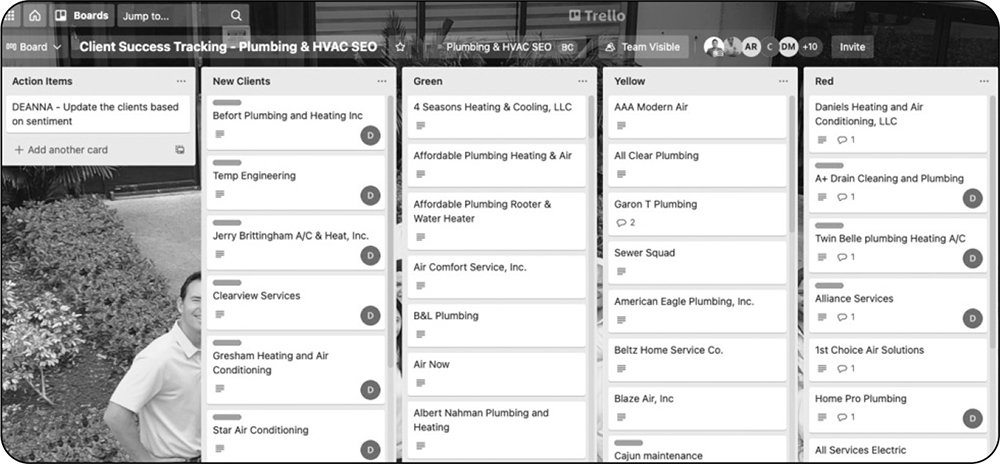
You then put a process in place where your account management team, plus you or whoever’s in charge of account management, is meeting every week and looking at the clients that are red and yellow.
To move those clients back to a green state, you need to figure out what you will do this week, either from a results perspective or a communication perspective.
This process alone will have a big impact on your retention.
As your agency grows, you’ll have less time to get involved in day-to-day contact with clients.
The way to grow while delivering high-quality service is having a strong account management team to handle the client relationships.
To help maintain and improve retention, it’s important to approach this in the right way.
The main steps you need to follow are:
Let’s look at each of these more closely.
Before you can recruit an account manager, you need to define the role you want them to fulfill.
There are three key decisions you need to make:
You need to define what parts of the client relationship you want them to take off your plate. The key elements are:
These are the key responsibilities of the account manager. You should set these out in a written job description. I’ve given an example on page 110. You’re welcome to model this for your own use.
Before we talk about recruitment, we need to think about the working model. There are two main approaches to building a team:
The virtual option has many attractions as it usually leads to lower costs.
Firstly, you don’t have to pay for their office space. You can also recruit staff from other countries or even other parts of the US where the cost of living is lower, and they earn less.
It can also give you access to a broader talent pool than you will find within your immediate geographic area. This can be particularly valuable if you are based in a smaller town, especially as you grow and need more people.
Many agencies have great success recruiting staff in the Philippines, for example, where the standard of education is very high, and you can recruit staff who speak English very well. The hourly cost is significantly lower than recruiting people in the US.
Even within the US, the virtual option has grown in importance now that remote work is normal and many people have decided they prefer working from home. If you go down the virtual route, you can also employ US-based staff at lower rates.
While there is a cost-saving in going virtual, you must set that against the attraction of building a team of people who all work together in the same location.
Although there may be a smaller talent pool to draw on if you recruit locally, there are benefits of having people in an office where you can see them face to face.
One of the best parts of that is the teamwork that happens as people know each other better, and there is a synergy that comes from people working closely together consistently. Brief conversations and ideas get sparked by people just being together.
So, if you’ve got a completely virtual team, you’ll probably find it leads to greater profitability, but you do give up some advantages to achieve that.
Sometimes recruiting virtual staff can be an easy way to get started if you are still building up your agency. But one thing I’ll say is that it’s generally best to choose one option or the other.
For example, if you have an in-house account management team of five and then somebody randomly gets hired to do the same job in another city or country, it becomes difficult to manage.
So, choose one option and stick to it as far as possible.
For the first 7 years of the business, we hired locally based, English-speaking people who worked out of our office in our agency.
When we first shifted to working from home, it worked well on a virtual basis. We’ve since started hiring US based Account Managers from across the country and really enjoy having access to a broader talent pool.
As owners, we all get to choose what works best for us in terms of where we are based, how we plan to scale, and what we’re looking to do within our businesses. So, you can decide what seems right for you.
The next question is how much you will pay your account managers.
The exact numbers will vary in different locations, but I will suggest some numbers that will work in most parts of the US as a benchmark.
I think you’re going to want to pay the account manager between $35,000 and $55,000. You want somebody that’s going to be full-time, fully dedicated.
You may want to use a sliding scale to start a bit lower and build up over time as they get trained up and can add more value. For example, during the training period of 90 days, they might earn $35,000.
During that first 90 days, they learn the basics of the job, such as how to go through the launch process and how to conduct a monthly review call. When that is complete, they then go to $40,000.
Then, once they are fully trained, doing a good job, and have a full load of 30 to 35 clients, they will be increased to $45,000.
Among our Seven Figure Agency members, top account managers with several years of experience and solid relationships with clients can even go into the $50,000 to $60,000 range.
A manager leading a team of account managers and contributing to the business in other ways could go even higher.
Some people look at these numbers and think they can’t afford to pay those kinds of rates.
If you look at these numbers and feel you can’t afford that right now, bear in mind that everything goes in stages. Maybe you prefer to start with virtual staff. I would always however recommend a US Based or Expatriate for Account Management Roles.
I’ve seen some agencies starting with most of the team in the Philippines. It doesn’t mean that it is set in stone. You’ll continue to evolve. As you grow, you pay more, and you attract better talent.
The other point to note is that if you’re going to pay somebody, say, $35,000 a year, you don’t need to have $35,000 in the bank to hire that person. I recommend that you have at least three months of their salary in the bank.
The key is to feel confident that you can bring in more clients if you have more free time. That’s almost always the case. If you free yourself up in the first 30 days, by the 45th day of that 90-day window, you’ll be bringing on clients faster than you probably have ever done in the past.
That will happen because you can focus on getting new clients versus dealing with clients filling your schedule with day-to-day requests for all kinds of things.
In the early days, many agencies feel they can’t afford a full-time account manager, or they want to hire an account manager who is also going to be the production manager.
We’ll talk about the right skills for the job, but in that situation, I suggest you hire two part-time people from the Philippines that speak excellent English. One will be good at holding the client’s hand, which you need. And the other one’s going to have a list and check it off and get things done, which is a different skill set.
Some agencies have also successfully hired people part-time, particularly if they hire virtually. Interest in this has grown quite a bit as remote work has become standard.
Many people are looking for that 28 hours a week job; they don’t want to work for 40 hours.
Often these are moms with kids that have time available during the day but can’t work full-time. They will do a great job, and your cost will be much reduced because of the lower hours.
On top of the basic pay, it can be helpful to incentivize the account manager through a bonus based on factors such as client retention and upsells.
For example, you could pay a $500 quarterly bonus if retention is greater than a certain amount. Make it a stretch based on a reasonable retention rate within your business.
So, if you’re averaging 97% monthly retention, they could get a bonus if they can retain their base of clients every quarter at 98% or 99%.
On upsells, if the account manager provides excellent service and the clients see value in doing other things with you, you could incentivize them. For example, you could pay them a bonus of 20% of the first month’s billing increase.
Something else you could do is incentivize them to get video testimonials because that’s the culmination of creating a great experience.
Bonuses like this can be advantageous but aren’t necessary.
Once you have defined the role, you need to find the ideal person to fill it.
The three main elements to this are as follows:
Let’s look at each step.
When you have defined what you want the person to do, you need to identify who is the best type of person to carry out the role.
One of the mistakes we sometimes make as entrepreneurs is trying to recruit people just like us.
We want to find somebody as good as us at interfacing with the clients, having great business conversations, and making the sale.
Usually, as entrepreneurs, we tend to like starting things. We often don’t enjoy the perpetual nature of follow-through. We don’t want to have to do the monthly calls. We don’t want to follow checklists.
When recruiting an account manager, you are looking for a different personality type. You are looking for an A-player with the right personality profile.
Often, when I talk with agencies, they think any person they bring into their company should be able to step in and be the catchall.
They think they are going to hire someone who is going to handle the clients, but also be the operations manager plus do some sales calls.
You’d be surprised how often I hear that someone thinks these people will do everything in the company. That’s not a realistic expectation.
Early in the agency, the tendency is to think the person who’s going to manage the relationship is going to set up the pay-per-click campaign, or they’re going to run the Meta ads, or they’re going to do the work for the client as well.
Your account manager isn’t doing the SEO for the client. They aren’t building the website. They aren’t doing the physical work.
Your account manager is managing the relationship. They’re managing the touchpoints.
Now it’s not lost on me that if you’re only at 10 or 15 clients, and you’re ready to try and get somebody to help, they might need to have a broader position scope than this. But eventually, as you grow, as you scale, your ideal account manager will be able to handle 30 to 35 accounts.
The primary responsibility of the account manager is launching new clients, doing the monthly review calls, and being the central point of contact between the client and the team that will do the work.
That is a clearly defined role, and a specific type of personality is suited to it.
We identify whether a particular candidate has the right personality profile using a series of tests. I’ll talk about those in a moment and outline how we use them to make sure we choose the right person for the role.
However, before you start the recruitment process, you need to know what type of person and what personality profile you are looking for.
To find the right person to fill the role, you need to advertise the job to potential candidates.
The best place to do that depends on where you are. It may be an online site like Indeed or LinkedIn, or perhaps you have something that works better in your area.
You need to give details of the job and the type of person you are looking for.
On page 117, I’ve given an example job posting. You can use this as a reference point but make it your own.
In listing the job, you should sell the company and sell the opportunity in the posting.
Don’t just say, “We’re looking for an account manager that can manage our clients.” Talk about the company and the industry and the role’s opportunities.
When you’ve listed the job, you will start to get some applications in, and you need to have a process for identifying the most likely candidates.
Before we get too far into this process in our agency, we use various psychological tests to help weed out unsuitable people so that we only spend time with people who look like they have the right attributes.
As I mentioned earlier, your account manager’s personality profile is different from the personality profile of your production people, the people who are pushing the buttons and running things in the background.
As an account manager, you want somebody who will be comfortable on the phone, who has confidence, and has strong influencing skills.
Cross mingling these responsibilities, you might wind up with somebody that’s good at communicating with the clients and the clients like them, but poor in their core responsibilities.
When we receive applications, we do a quick review to see if the person is a possible candidate, and then we ask them to take a personality test.
One of the main ones we use is Kolbe. This is a profiling model that looks at how people tackle challenges and measures them in four different categories:
I always look for account managers who have strong attention to detail.
So, you want somebody that scores relatively high in Fact Finder. That will tell you whether they have attention to detail, whether they are the kind of person who pays attention to dotting the i’s and crossing the t’s.
You also want them to have a high Follow Thru. This will tell you if they will be ready to take whatever action is necessary to complete the task. Are they going to be comfortable doing the same things day-in and day-out, week after week, month after month?
Ideally, you are looking for a Fact Finder higher than five and a Follow Thru not less than five—the higher in those two areas, the better.
Our top account manager profile is 7-7-3-3.
When the Follow Thru is high, at least a seven, these people love making lists. They love giving you friendly reminders to send things to them.
Fact Finder is about being detail-oriented, which is important.
My rule of thumb is that I will not hire someone for this type of role if they’re not at least a six in Fact Finder and at least six in Follow Thru.
The problem you’ll have is that people who apply for these kinds of roles will come in, and they’re going to wow you with how well they articulate things and how smart they are.
But they’re usually going to wind up being high on Quick Start.
They seem great initially, but they collapse on you three to four months in.
In practice, they are not what they promised or what they appeared to be at the interview. They didn’t follow through on things.
If I had known about the Kolbe assessment from the start, and looked for Follow Thru of six or greater, I would have had more success in recruiting high-quality account managers and, ultimately, in improving client retention.
I will add that it’s not the only factor you look at. You could have someone that fits the Kolbe profile, but culturally they don’t fit. But it’s a great starting point.
This also helps you as a leader to understand their way of thinking, so you don’t get frustrated when you must explain things more thoroughly to a Fact Finder and give them more details.
You can’t just give them an idea and expect them to go and implement it. They need a little bit more direction, more information.
So, Kolbe can help you on the hiring side, and it can also help you on the management side of things.
It helps team members understand how to work with each other and how to communicate so that they are giving the right amount of information depending on the person they’re working with.
Another approach we use for psychological profiles is the DISC model, which is based on four distinct personality profiles measuring Dominance, Influence, Steadiness, and Conscientiousness.
You want somebody who will be relatively weighted towards the I and D personality profile for the account manager.
They’re confident talking to people. They’re not going to be scared to get on the phone and have a conversation. They are less likely to hide behind their email.
They will also be able to hold their own when the client complains or expresses frustration. They must be able to maintain the confidence of the client.
The ideal mix is probably more on the I side of the DISC profile and six or higher in Fact Finder and Follow Thru.
If you look at those two criteria before hiring people, it will not be a silver bullet. Still, you’re going to massively improve your probability of finding somebody good.
You’re more likely to find somebody that’s going to stick with it, and that’s going to serve your clients well in the long-term.
In all these systems, it’s important to remember that there is no good or bad overall.
It’s about matching the right person to the right role.
We use these quite early in the process to help determine whether we should spend time interviewing somebody.
I want to pre-screen them a little bit and see if I think they might potentially be a good fit. You don’t want to be incurring a cost for sending out assessments willy-nilly.
If, when they first apply, they seem to like their experience is suitable, we would have a pre-screen call.
We talk about their goals, strengths, and why they think they’d be a good fit.
If they feel like a good fit, I’ll usually have them do the Kolbe assessment at that point before going much deeper into the interview process.
There is some cost involved in this. Kolbe, for example, runs roughly $50 to $100 for each assessment. But bear in mind that the results can prevent you from wasting time interviewing someone who is not suitable. And the cost of a bad hire is exponentially more than that.
Think about if you hired someone you thought would be great because they sounded good, but they turned out to be low Follow Thru or low Fact Finder.
You might start to introduce them to your clients as the account manager. Then, two months in, three months in, either they drop the ball or flake out on you.
That is what often happens with high Quick Start, low Follow Thru people.
You will have lost clients. You will have lost time. You will have lost many things.
Spending $50 to $100 on tests, even if you had to give it to 10 people on the front end, is therefore money exceptionally well spent.
Once you have the right person on board, you need to take steps to manage their performance using the right measures.
The three key parts of this process are:
Let’s look at these in more detail.
When someone comes on board, you need to set clear expectations and find a way to measure their performance.
We need to make it clear what we expect from them. What do they need to do and what are they going to be held accountable for?
We need to identify the correct KPIs, or key performance indicators. We need to know if they’re doing a good or bad job. The key to that is whether they are hitting the appropriate metrics.
There are some key metrics that we can track that make it easy to tell if the account manager is on-track or off-track.
Naturally, you must monitor their quarterly client retention rate. Their primary function is to provide a service to retain as many of their clients as possible. So, you want to track how many clients they lose any given quarter as a percentage of their client count and then how much revenue they churned.
You want to figure out what the proper benchmark is for your business. It’s different for everybody. Some people retain much higher than others, so you want to manage that expectation.
While it’s essential to measure the actual retention rate, this is a lagging indicator. You’re looking back after the fact to whether they retained the client or not.
You therefore also need to have some KPIs that tell you if they are doing the activities that will maximize the retention rates.
One of these measures is the percentage of clients met monthly for the review.
Not every client will give an hour of their time to do a monthly review call, but we shoot for 75% or higher per month on the client review process.
So, if they’ve got 35 accounts, we want 75% of them to have met and gone through a meaningful monthly review call.
If they didn’t have the review call, they should shoot a Loom video with a meaningful recap, “Sorry, we couldn’t connect. I know you’re busy. Here’s what’s in the reports. Here’s what we accomplished. Here’s what we’re working on next. I’d love to jump on a call with you to talk through this.”
Another way we can monitor the performance of account managers is by tracking feedback.
You must have some type of process, whether you’re doing this yourself or it’s done by the account managers, to check in with the client base and monitor these questions.
We can do this through a net promoter score or a survey to ask, “On a scale from 1 to 10, how likely would you be to refer us.” You could do this once a quarter or more frequently.
Another angle you could measure is what percentage of clients are so excited that they would gladly refer your agency to others.
If they’re getting lots of ones and twos, or even fives and sixes, perhaps the clients aren’t happy. If they’re frustrated, they won’t refer you.
We need to make sure that we have that communication and feedback mechanism built in so that we’re not just looking at the cancellations flowing in, but we can get ahead of it.
If the clients are frustrated, if they’re saying things aren’t the way they should be, if they’re not getting the type of follow-up they should, let’s catch that early instead of seeing it late.
Another one I’ve just started tracking is how many clients have submitted a testimonial video on their behalf.
Certain account managers are going to be better at this. The best ones will be creating such a great experience that the client will gladly shoot a testimonial video.
One more element you can track is the number of problem clients every week. That’s the people that have raised their hand and said they’re not happy.
You can also track upsell revenue. You can break that down by one-time revenue and recurring.
So, you do want to give them clarity on what their roles and expectations are.
As you’re training and managing, you need to make it clear to them what your expectations of them are, what their position entails above and beyond just retaining your clients at the highest level possible.
As an account manager, you are responsible for managing the relationships with named clients. The bottom-line function of this position is to retain our clients and ensure the transition of clients from satisfied to thrilled.
The candidate must be flexible and be able to multitask across a variety of job duties, including:
Plumbing & HVAC SEO is a Full-Service Internet Marketing company based in Miami, Fl, that helps local businesses increase their sales, improve customer retention, and enhance their profitability by more effectively marketing online via Search Engine Marketing (SEO & PPC), social media (Facebook, Instagram, X, LinkedIn, Google Business Profile, etc.) and other online marketing platforms.
The company has been recognized as one of South Florida’s Fastest Growing Internet Marketing Firms.
At Clic Inc, our employees are our most valuable asset—a group of talented thinkers, dreamers, and doers who move the industry forward and provide our clients with impeccable service.
You will find a one-of-a-kind culture within our walls that empowers the industry’s brightest individuals to do their best work. In this culture, each individual is encouraged to develop their professional goals further.
At Clic Inc, the journey is just as important as the destination.
As an account manager, you are responsible for managing the relationships with named clients. The bottom-line function of this position is to retain our customers and ensure the transition of clients from satisfied to thrilled. Our company mantra is “All 10.”
The candidate must be flexible and be able to multitask across a variety of job duties, including:
The online marketing / SEO industry is rapidly changing. Consolidation will continue, which results in less opportunity for career development, even if you are talented. The Internet Marketing Space is an exciting industry where you can maximize your years of experience.
Want a new change and to be part of a dynamic environment with a growing company?
If you’re a hands-on, highly driven, analytical, and creative person who wants to work in an environment with other industry experts, this established, financially stable, and growing company could be the right place for you.
Are you the right person to take this challenge on? If so, please e-mail your resume now.
I recommend setting up a centralized system / process for managing your client experience. We do this with a customized Snapshot built in HighLevel Software.
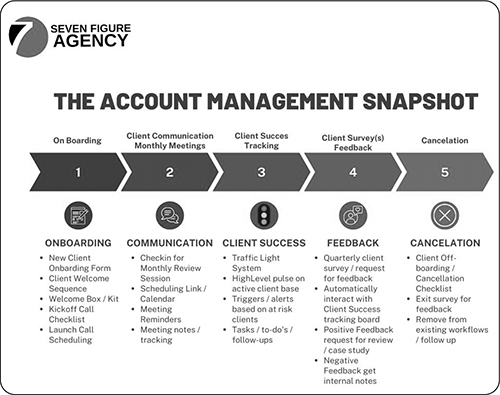
In this book, I’ve shared a proven roadmap for keeping more clients on board for longer and reducing churn in your agency.
The roadmap covers the following three phases:
Let’s summarize the key aspects we went through.
We identified that what happens in the early days of the relationship can be a major factor in how long a client decides to stay.
That’s why the first phase of the roadmap is a carefully designed, World-Class Onboarding Experience
The three key elements of this are as follows:
The second phase of our roadmap is Effective Communication. We want to ensure they understand clearly what we are doing for them, and they are aware of the results they are getting.
The three stages here are as follows:
Most clients are constantly being bombarded with offers from other digital marketing agencies.
You need to ensure they always feel that you can take them forward. That’s why you should always be seeding the vision of what’s coming next.
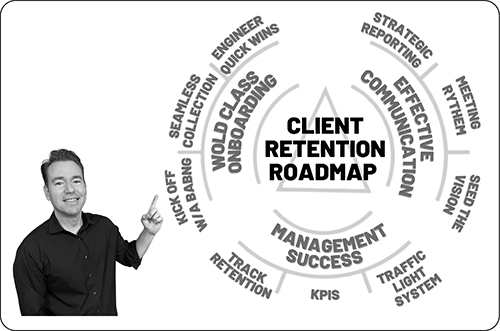
The third phase of the roadmap is the business side of client retention. It covers how we manage the agency internally as it grows to ensure we get the highest possible client retention.
The three keys here are:
Overall, these are the steps that we have found can lead to significant improvements in retention.
ONBOARDING | COMMUNICATION | CLIENT SUCCESS MANAGEMENT |
Dial in your onboarding process Setup a multi-step new client capture form to simplify to collection of login details Flesh out your “OnBoard Call” script Think about where you can engineer “quick wins” into your service offering Start sending a welcome / thank you gift (basket or custom box) to new clients Roll out an OnBoarding sequence to set expectations, indoctrinate in your process & enhance communication Start communicating every step of the way as micro-steps are complete in your OnBoarding process | Re-work your reporting to focus on the KPIs your clients care about most Map out your “Ideal Monthly Review Call” Commit to meet with every client at least once per month Build out a weekly touch process to connect with your clients, share outcomes / results & next steps Shoot a Loom Recap video for clients that can’t or won’t meet live each month Focus on seeding the vision & what you will be doing for them over the next 60-90 days | Account Management You’ll need a Full Time Account manager for every 25-30 accounts Develop Account Management Recruiting, Training & OnBoarding Process KPIs Setup your Sales & Retention Tracking Sheet and commit to know / track your Monthly Client Retention Rate Track your Account Management communication metrics Shoot or at least 97% monthly retention rate Traffic Light System Add all your clients to a success tracking mechanism where you can gauge who is Green / Yellow / Red Work your Client Success System weekly and proactively move Red’s to Yellow & Yellows to Green Setup your Client Account Management Snapshot on HighLevel |
In the final segment of this book, several of our Seven Figure Agency members will share what has worked best for them to improving retention in their agencies.
I hope you find this whole book helpful, and I encourage you to work on your own roadmap.
I’m sure you’ll find that it helps you reduce the churn in your agency and keep more clients on board long-term.
If you are serious about growing and scaling your agency and want some help from me and my team, let’s jump on an Agency Acceleration Session.
Here is a link:
www.SevenFigureAgency.com/Schedule

On that call we will help to get clear on the fastest path to grow and scale your agency.
We’ll also discuss how we can work together to help you implement the strategies outlined in this book to improve your retention.
Thank you for spending your precious time reading this book. I hope it has been of value to you and will propel your business to new heights.
I wish you tremendous success and happiness. I look forward to meeting you in person soon.

Rather than just giving you my viewpoint, in the next segment, I want to share with you how some of our Seven Figure Agency members are succeeding in improving their retention.
They come from different markets, approaches, and different stages of business growth. So, they give a broad picture of what is working today.
I hope you’ll be inspired by their ideas and adapt them to work in your own agency.
We have a good onboarding process and a reasonable retention rate, and we continue to improve and refine what we do.
The key is that you must follow the whole program and execute it. If you follow the program from kick-off through to getting clients some quick wins and getting the website launched, you will have happy people, creating stickiness. But you must communicate.
The words I like to use within our team are “managing expectations.”
When I talk to a new client, and they’re ready to sign up, I start to manage the expectations of what’s going to happen next.
It happens very quickly; little things like when they get their gift basket, we create engagement.
When they get their gift basket, we ask them to take a picture of their team holding the gift basket. We ask that they put it on their social media, and I then send the photo to our social media manager so we can post a picture of them and their team holding the basket. That just creates additional engagement.
If you can execute and perform and get the wins, that will help, but attribution is critical.
When you use a tool like Agency Analytics, you can show them the attribution of the calls and the conversions. We communicate with them monthly, and even though they have 24/7 access to Agency Analytics, they don’t necessarily look at it.
So, we send them a list of all the names from all the calls they got (excluding calls less than one minute) and any conversions from the Facebook campaigns that we’re running.
We ask them to get back to us with the attribution. So, we know what their conversion rates are like internally. That’s going to create stickiness.
We’ve continued to refine that. Sometimes they’ve already got somebody doing social media, or they might have another agency doing pay-per-click for them that they’re happy with, and they don’t want to leave them.
However, we’ve had other agencies try to take credit for our work. So, in all fairness, we’re working on a closed-loop attribution system, so we know that we’re getting credit where credit is due.
If you do not have monthly calls with your clients, even if it’s down to a 15-minute call, just to do a quick review of the Agency Analytics and any changes or any edits, you need to do that.
Some of our clients are so busy, they’ve moved it to quarterly. Some of them are so busy that they’ve moved it to annually. They just know their phone’s ringing because of the work that we’re doing for them.
If you’re not getting great results, the bottom line is you will struggle with the retention bottom line. So, you must execute on the delivery, and you’ve got to perform. That makes the retention that much easier.
Our retention rate is about 99%. So, one of the things we implemented is an internal Retention Bonus Program.
Depending on your retention level, you will get a specific bonus, and we pay that quarterly. My administrator keeps track of all this.
So, if the retention is 99% or higher, they get X; if it’s 98% to 99%, they get Y. If it’s 97% to 98%, they get Z. If it’s below 97%, they get nothing. It is based on revenue rather than number of clients.
When you are thinking about retention, it’s essential to understand where your customers are in their journey.
I learned the importance of these concepts after I set up my martial arts school.
Working predominantly with children, you know they want to try something new every other week. We knew there would be days when the kid doesn’t want to come to martial arts. They’d rather stay in the pool during the summer or hang out with their friends.
We recognized early on that the relationship with the parent is ultimately what kept those kids coming in those inevitable days that they didn’t want to go to martial arts. So that was driven home in the martial arts school.
One of the things that I noticed when I started the agency was that I would go to many in-person events in the industry, where I might be speaking.
I would run into clients who had tried our services and canceled for whatever reason.
I started getting stressed out about going to these events because I’d have to get face to face with these clients. Our model is predominantly Facebook ads, and there are some months that we knock it out of the park for them. But then there are other months where the cost per lead went up because they have more competition.
We had to work out what would keep them with us, especially when every other marketing agency is cold DM-ing them to make these outrageous promises.
Ultimately, our relationship with them makes the difference and we build that relationship through our communication methods.
When I read the book “Never Lose a Customer Again” by Joey Coleman, it was eye-opening.
It identifies these ten stages of the customer journey, though I thought that was just a little much.
We recognize that certain customers are in different journey steps, and there are six stages that our customers go through.
Whether you own a martial arts school, a dance studio, an HVAC company, or a marketing agency, these are the stages.
The first one is awareness, and we’ve got to get people aware of us before we can get them to consider us. And that’s the second stage consideration.
The third stage is purchase. We want to get them to pull the trigger to act.
The fourth stage is onboarding. I genuinely believe that retention starts in the onboarding phase.
The clients’ initial response helps dictate how long this relationship will last.
Fifth is retention itself. What are you doing to retain those clients? Well, the number one retention strategy is giving them great results. If you want to keep your clients, you’ve got great results.
But there are a lot of other aspects that you can do as well, which I’ll cover in a moment.
Then finally, the last stage of the customer journey is advocacy.
We did an exercise recently after this massive cancellation where we went through all those stages.
We looked at each phase, starting with considering when that point of contact starts. And we said these are the different ways we can communicate—via social media, email, snail mail, sending a video, by phone, in person, or via gifting.
The issue for us was whether we could scale this with 250 plus clients. We wanted to do all seven communication rhythms at every stage. So, we collaborated as a team and asked ourselves how, at the consideration stage, we were communicating through each of those methods.
Then we did that for every single stage, and we implemented it.
Those cancellations were just starting to come in during January, and after we made those changes, we only lost three clients in February. So that was huge for us.
We realized the importance of looking at people based on the stage that they’re in and identifying how best to communicate with them because that’s ultimately how relationships are built.
I think many people drop the ball in onboarding. Why? Because we get the purchase, and we’re pumped, and we’re excited. So, what do we do? We want to get the next purchase.
But why do you need all these purchases? Yes, we need more clients. But acquiring clients cost money. You wouldn’t need as many new clients if you could keep them.
That relationship starts with awareness through your Facebook ads and how you’re sending out cold emails. But I think too often that agencies drop the ball with onboarding.
It starts in the first 90 days of the relationship. You’ve got to knock that out of the park.
Here are some of the things that we’ve implemented for retention in our agency. We have an online training academy where clients can log in, and we have training videos for the staff.
I can get them all the leads and appointments in the world, but if they don’t have a conversion system to close them, they will tell me that the leads are garbage.
In addition, I teach a monthly masterclass to all our clients on a different digital marketing topic to help them stay in the know.
We also send mailers out like handwritten cards, old-school style. We want to be in their mailbox. We send birthday cards and anniversary cards.
Another aspect we include is thoughtful actions. We’re trying to be friends with everybody on Facebook, and you see that somebody’s dog died, or somebody just got married, so we interact. We look at those as thoughtful actions.
It’s a great retention strategy, but that’s not the only reason you’re doing it. It’s because you care.
Then we also do milestone gifts. We recently implemented sending Shari’s Berries when they hit their first anniversary with us, second anniversary, three-year, etc.
I don’t know what it is about food, but everybody loves food. Sometimes you’ve got to think about whether they are gluten-free and stuff like that. But every single time we send these Shari’s Berries, which costs about $20 to $25, they take a picture.
They tag us on Facebook, and they go into our Facebook group and thank us. And what did that take us? Four minutes to put that order in online.
The goal is to get our clients to be walking billboards for our agency.
I think that’s the stage I’m in for Seven Figure Agency. I am an advocate, I am a brand ambassador, and I don’t get anything for that. It’s not like an affiliate link. I do that because I believe in this program so much.
That’s where we want to get all our clients. We want to get our clients to that advocacy stage to make those referrals.
Because, in my opinion, there is no better prospect than a referral prospect.
If I had a choice of getting a referral prospect or getting a prospect off a Facebook ad, I’m going to take that referral every day of the week and twice on Sunday.
So, start looking at retention from day one at the awareness stage with your messaging and speaking to people. But I think where the ball gets dropped the most is in that onboarding phase. Because we’re looking for that next sale. We’re looking for that next client.
Your goal should be to get them to move step-by-step into the advocacy stage.
I believe that if you’re not getting results for your clients, you’re not going to have good retention.
We do leads for water damage, mold, fire, and those types of jobs. We currently have a 99% retention rate. We only have 25 clients, so I’m not blind to the fact that, as we grow, that retention rate is going to go down. Though hopefully not by much because of the systems that we implemented.
For me, mainly as we’ve grown, it’s been about making sure that clients know that we’re a partner with them and not just a service. Once they become indifferent and think that you’re not a partner with them in helping them grow their business, you’re just something they can cancel like a monthly membership.
If they understand that they’re a partner in building that relationship and have that trust with us, it will go a long way.
To achieve that, I currently give them my cell phone. Though, as we grow, we’re not going to be able to do that all the time. That’s why we hired an account manager to manage that communication going forward.
The most crucial aspect for us is communication. It’s not just communication about rankings and their stats for this month. It’s about communicating the results to make sense to them.
We look at three things:
So, they have some sort of roadmap to understanding what’s going on and where they’re going.
The primary way we do that is with call tracking. We will not only report call stats, but we will make sure that those phone numbers mean something to them.
They have names associated with them, and there are job types and a value associated with them.
So, when a client is onboarded, we know precisely what a converted job to them is worth, whether it’s $3,000, $5,000, or whatever.
When we show them the qualified calls, they have a name associated with them, a job type, and a value.
So, you’re reporting on data that is meaningful to them.
You’re not always going to go up every month. So, when we report, we want to make sure that, if something is going down on that future side, they know exactly what we’re doing to address that.
For instance, we had a client a couple of years ago, and they’re still a client today because we explained that their call volume went down due to two new competitors in their market who were spending a lot more money on pay-per-click.
With that approach, they understood what we would do going forward to make sure that we would produce improved results.
Two years later, they’re still one of our biggest clients. So, it’s all about communication.
Sometimes clients do cancel. We had two clients cancel this year. But one came back because of our offboarding process.
We had a great experience, but they had something happening on their side that we had no control over. We had an excellent offboarding with them, and two months ago, they signed back up with us.
When things do go sour, I try not to take it personally. I try not to take it to heart. I always carry around a list of my circle of people in my wallet that are allowed to get into my heart.
So, if I think with my mind and business strategy, I will be much more level-headed.
If you let it control what’s in your heart, you’re going to have a much tougher time, and you’re going to get knocked down.
That gives me my “why?” That keeps me focused and keeps me grounded when things do get tough.
We serve CPAs and tax professionals, and we have 250 or so clients. I’ve been doing this for quite a while and have a slightly different approach compared with many others.
I come from the Dan Kennedy school, and he would always talk about the great copywriter Gary Halbert. Halbert would walk up to the stage to speak wearing a t-shirt that said, “I Hate Clients.” He’d say, “I’m not taking anybody.”
Then, after his presentation, he would have a line of people saying, “But you’ll take me, right?”
So, from the beginning, I have not given my cell phone, and I have not made myself accessible to our clients. I hired earlier than many people say you should when we were very small, and I don’t speak to our clients one-on-one.
That was a decision that I knew that I wanted to make for the sake of my life and the sake of scalability.
We have now scaled to the point where it makes sense that I don’t speak to clients because there are 14 of us on my team.
But that required me to hire people who would care deeply about results and our clients.
If I wasn’t going to speak to the clients, somebody had to. So, I hired my now business partner, and he handled this initially.
Then, when he got overwhelmed with work and operations, we hired more people. So, we scaled that way.
From the beginning, we created a model where we wouldn’t be bending over backward to make everything perfect.
The only way that worked was we had to set expectations from the beginning when we onboarded a client that this was how it would be. “You’re not going to get direct access to Nate.”
It set me into an authority positioning so that, when I did occasionally speak to clients, it was a big deal to the client. They felt cared for and loved.
I would intervene, and I still do occasionally, but now we’ve got layers with other directors in an authority position. They are the ones that they’ll get involved if we need the special touch.
We have a team of people that takes care of all our clients. We don’t do the account manager model. We have a client happiness team whose goal is communication, communication, and communication.
We also have what we call Project Peacock. We go overboard several times a year, sending them all the stuff we’ve done for them.
One of the keys to building an authority positioning is being a student of your industry.
Many agency owners come from the marketing world into the niche that they have decided to serve, but they are not experts on the niche. You need to lean into what your clients experience regularly.
For example, we work with CPAs, and there’s a great seasonality to it.
There’s also a variety of different niches within the industry. Some people do taxes, and others don’t do taxes.
We’ve been a student of the industry and speak about industry happenings to our clients. Most weeks, I write a broadcast email to both clients and prospects, and I talk about industry dynamics.
I’m setting myself up as an authority. I’m speaking directly to them, not about marketing. I’m talking about many things: leadership, sales, management, mindset.
That makes a big difference in our positioning both on the client side and the prospect side.
We do a weekly “office hours” call during the busiest time, tax season. It’s a Zoom meeting with however many clients show up. We have some content that we bring, record, and put into our members’ area.
We have a members’ area for all our clients, which is also helpful where they can access all kinds of recordings and all kinds of content.
As well as being great for retention, it’s one of the best lead generation things that we have. Our whole call to action on our website is “Become a free member.” Then as a benefit of the free membership, they get a meeting with us.
But these free Zoom meetings, group coaching, and all the recordings are becoming a big deal to our clients.
One important thing this authority position has allowed us to do is to create pain of disconnect with what we do, which is also different from what many others do.
We do a weekly nurture email on behalf of our clients. It’s written in the first person, and they send it to their existing clients and their prospects.
They love it because it’s email marketing done right. It’s not like tax tips and newsletters. It’s not like the generic content in whatever your industry would be. It’s written as though our client went through the effort of writing this thing to their list.
We do it weekly, and we have multiple tracks depending on the different client types. So, we’ve had to build software that enables us to create a personalized piece of content for each of our clients.
We’ve had to learn to write this so that we are writing in the first person on behalf of our 250 to 300 CPA clients, and they are comfortable sending it in their name.
If you do it long enough, clients don’t want to stop. They want to get this. Some clients don’t care about new client acquisition, but they’re paying our fees, and they’re happy because we’re nurturing their existing clients for them well.
Another piece that we do is we under-promise and overdeliver. From the beginning, when we set those expectations, we tell them we’re available for them to call from 12:00 PM to 4:00 PM every day. We’re available more than that, but that’s what we tell them. And when they can reach us, they feel great.
So, we’ve kept them at a distance while also putting them in a warm embrace at the same time.
We did that before we were large. We’re about $1.5 million in revenue now, but we did this when we were $300,000, and we just had a few clients.
I’m glad we did that because it’s enabled me to have a life while I built this thing, and it’s helped my clients as well.
We probably had less retention for a while, but now, we’re excellent.
We found that our retention went up as we raised our prices. As people enrolled with us at higher levels, they were happier. So, we’ve increased our prices. We’ve tripled our pricing over the last four years. And I’m very thankful for that too.
Retention issues can be emotionally draining, whether it’s just one person or shared by the whole team.
We find that our client base follows the Pareto principle, where 80% of the work is caused by 20% of the clients. We would say it’s like 95/5 for us—5% of our clients are a drag on 95% of our systems and our client happiness team.
We started deciding early on to fire clients if they didn’t fit our model or our communication structure. It doesn’t happen often, but sometimes, it’s best to approach these situations from a position of abundance.
If you are doing the right things, there will be more clients. We’re growing.
Another thing we have is a “Wow Budget.” We’ve given our client happiness team a monthly budget. We’ve created a culture of caring for our clients personally besides just getting leads.
It’s just a few hundred bucks a month, but if a client is talking to our team and there’s some issue in their family or whatever, we’ll send them a $75 gift basket.
It’s not every client, but we’ve told our people to keep a spreadsheet, and they’ve been given a dollar amount that they could spend. That goes a long way when clients feel cared for personally.
As far as retention goes, I focus on building a relationship with the client.
One of the biggest things that made a difference for us is finding your customers and talking to them. Please find out about conferences and trade shows they go to and things like that. See where they’re going and go there and be with them.
We’re sitting in front of a computer all day; we don’t have that one-on-one personal experience.
Zoom helps that. But getting our clients on Zoom is challenging because many people in lawn care often don’t have access to the technology.
The biggest thing that I feel has made a difference in our retention is building that one-on-one relationship.
The other key is being accessible to your customers. As you get bigger, it becomes harder and harder. Once you get over 100 customers, it becomes challenging.
Honestly, I don’t know every customer we have personally because I just don’t talk to them that much. That’s something that I need to work on.
But, as a smaller agency, if you focus on those things as you grow, it’ll keep your retention up and will help you keep moving forward.
Often, a big problem in the agency world is that we don’t set the pace, we don’t set the tone, we don’t set the cadence.
That’s a big retention tip. I want to set the tone right out of the gate on what’s happening at every step. I realized early when I started looking back at our email communications. I looked back at where we were lagging with the communication.
I looked at the dates where we would get the most inbound communications, whether a phone call, text message, or email from a client wanting more information.
I then just flipped the script around to become more proactive. For example, we used to do a monthly reporting call. We switched that over to having a templated email, sending the top three wins for the week. Then we had the two things we were working on that may be concerning.
Here’s the thing, when things slow down for business owners, whether that’s Friday night, Sunday, or Monday, they’re hitting your inbox or calling you because they’re saying, “Man, we’re not getting any leads. What happened last week?”
We do not want to receive those messages. We’re on top of it. We’re proactive about it.
So, part of our culture in our agency is being proactive and being ahead of the game. We’re proactive if something major, like a significant algorithm update, happens with that account. We have alerts set up via Slack for all our clients.
Instead of us getting a phone call, the account manager notifies the client, “We’re experiencing this issue with your Facebook ads, with your Google ads, with the current rankings,” or “There’s a new search snippet feature that just came on board, and it looks like our leads have gone down from this to that and we’re working on it.”
That stops the lagging, and now we’re proactive in getting right to the front. You can start looking at those communications strategically, and I can tell you that served us well from a retention standpoint.
Next is just transparency. I don’t want to hide anything from the clients, and I will not lie to them. I don’t want to keep them if I must keep lying to them. That is just part of my culture. I do not want to do that.
We’ll say, “This is what’s happening. We are dropping the rankings from here to here; you’re dropping off the maps. This is what we are doing about it.”
They care about that because they want to know they have someone looking after them, and we’re doing our very best.
Another thing is knowing what clients like to get as far as data and information is concerned.
I don’t send them ranking reports. Because I surveyed my clients and asked them how often they had looked at the ranking reports and how important it was to them. The answer was not many, maybe like 10%.
It’s also important to understand their best way of communication. We ask them if they like text messages, emails, phone calls, or Zoom calls for the onboarding call. Most of my guys don’t like Zoom calls.
The key is that there is a touchpoint happening every single month. “I just sent you an email / text message; check it out. Send me your feedback when you get a chance.”
Now, we’re leading the way, and they feel comfortable.
It’s also important to be ahead of the lag metric, understanding when clients start dropping off.
Go ahead and look at your calendar. Try to find a pattern for when they start canceling; they start sending those emails and see if you can spot a cadence or some trend.
You might find that after they paid that last month, you’ll get that message a week or two later.
So, what can you put in place that’s proactive, especially when you feel the relationship started to go sour?
That’s when the gifts come in handy, that’s when maybe I get a phone call, and my account manager says, “Hey, can you give this guy a call and just see what’s up?” They often get the phone call, and they say, “Thanks for calling me back. Can you investigate this for me?” “Not a problem. We’ll take care of it.”
It changes the game and maybe buys us another six months, whatever the case is. That has helped.
The average attrition rate across the industry is about 20% a year, which is a high number, no matter how you slice it.
Our retention rate has always been excellent. The key is that, in the past, we were able to talk to our clients on a one-on-one level.
So, we were always able to save a client or have those conversations with the client to get them to stay on the wheel longer.
As we’ve grown, we’ve started to figure out that we can’t do that all the time.
To get around that, we’ve implemented two things. One is client expectation in the form of a brief. Because we deal with attorneys, we want to use their language.
We’ve identified four different phases broken down into three-month increments in the document.
Our first phase is to crawl and then it’s walk and then run and then fly.
When we sit down and have these conversations with a client, we can look at when they became a client, and we can talk based on where we are in the process.
Early on, we can say, “Hang in there. The leads will start to come.”
Often, people think it’s an easy button, and in month four, they ask, “How come the leads aren’t flying in?” The truth is you’ve got to crawl before you walk.
The second thing is that we have what we call our GAS call. That stands for “Give a Shit.” It’s the call that shows that we care.
When a client moves to the red zone, we are notified, we set up a call immediately with the client, and we have this call where we show we care about them.
It’s a conversation about: “What’s going on? How do you feel? Why are you feeling that way? What can we do to improve?”
We extended the relationship almost immediately when we started implementing this with some of the clients in the red zone.
So those are two tips that I would implement immediately for any size of business. You don’t want to wait until you grow larger to implement these tips. You want to get ahead of it.
You need to make sure your account managers and client success managers understand the appropriate language and know what to do at the next step.
We work with realtors, and we’ve got a pretty good retention rate; we’ve had clients that have worked with us for 12 years that have never left.
One of the big things we do is put a lot of commitment into setting expectations early on.
We’ll say, “This is what you should expect from us. And if we don’t deliver it, we will give you the next month free.”
We encourage them to call us out if we don’t give them the attention they deserve. If we make a mistake, we want them to let us know.
But, in doing that, we turn that back on them and set the expectations we have for them. We tell them what we expect them to do.
We do pay-per-click primarily, so we aim to get quick results for our clients. But we make clear that our job is to generate the leads. What we expect from them is that they will follow up on those leads.
So, if we have a call with them about how things are going and they say, “We haven’t closed any deals or got anything hot,” that’s a red light for us.
We immediately dive into what they are doing. Are they just handing these off to an agent that doesn’t know what they’re doing? Are they doing proper follow-ups?
I like my account managers to have relationships with their clients, and I have relationships with some of our clients. We don’t just set expectations and say that we care; we like to show people that we care.
A big thing for us for client retention is that we don’t do contracts or set up fees. We’re only as good as last month.
For every client that comes in, some will call us out on it. If the client sucks, then we just fire them. It’s better to have a happy office than an unhappy office and a bad client.
As your business grows, you want to ensure that you attract clients and staff who believe in the same things you believe. You want people to care for the clients.
I believe that if you care about the account and demonstrate it, you’re 98% ahead of everybody else because many people in our industry don’t care.
One of the significant issues we have in our industry is that once a childcare center is full, it will be full for a long time.
For example, we’ve got a client in Canada right now where we took them from zero to $2 million recurring revenue within ten months.
The problem is that once that daycare center is full, it will be full for an extended period.
We have always seen the importance of seeding the vision and looking for ways to make sure that client’s going to stay with us long-term.
So, we looked at what else we could do to add value.
The key is not just about getting the inquiries to the door, getting those customers to sign up. We had to look at other ways to add value that we could then systemize to make them scalable.
We spoke to clients about what they were doing in their business, then found something we could take and roll out for every other client.
One example is that a big problem for childcare centers is room transitions. When a child moves up to the next age group, that’s a big thing for a child and a parent.
Based on what we learned, we implemented a system where we built a website page with a video introducing the team, and it would all be automated.
The center owners loved that concept, and that’s something that once we’ve built it for one client, it’s only a few hours of work for us to then roll out for everyone else.
So, the key is looking at how you can take something that a client has a problem with that’s not just about the front-end marketing. Once they are full, what’s the next challenge they have?
We came up with 97 different ideas of systems that we could roll out. We look at which one will have the biggest impact, and which one is the easiest for us to implement for all those clients.
The last point is that we are open with clients from day one that our goal is to have 400 clients worldwide. We want them to be part of this elite community, so it’s exclusive within a five-mile radius.
For example, if we’ve got a center in Sydney, Australia, if they share an idea with us, it’s not going to go to any of their competitors, but it will go to everyone else in the community.
That’s how we build this system. It delivers a fear of missing out. Once someone’s on board, they want to stay on board because they know lots more things are coming. It’s not just about filling the center.
We work with lawn and landscape companies, and retention is massive, so we’re good at it.
We must measure it annually because, otherwise, every month would look like 100% retention. Our churn was about 1.5% last year.
I recognize there is a big difference between businesses depending on their focus. We tend to have smaller customers with higher dollar amounts and more all-inclusive programs. Others may have higher volume, lower dollar amounts, and more specialized services.
I feel like you’re going to have a difference there. So, some of the things I’m going to say would not apply to everyone, and some wouldn’t be able to implement them due to their volume. Because we’re getting more per client, we can focus more on each client.
I see the influence on our client base as being 70/30. Their opinion will be 70% based on results, whereas 30% will be based on the overall experience and the communications.
When I talk about results, I’m talking about delivering great results beyond what is the norm. In that scenario, many times, the communications, and the experience are not all that important to them. That’s why I put it at 70/30.
But don’t get me wrong. If you don’t have the results, it doesn’t matter how much they love you. They’re still going to leave you.
We do a few things to keep the pulse and ensure things are working well.
One is that we’re all-inclusive. So, we’re able to offer quick wins right away.
We offer a long-term strategy. We do paid ads, SEO, building reviews, email marketing, reactivation campaigns, SMS, etc.
Those things that deliver quick wins… the SMS campaigns, the email marketing, the review building, Google ads, Facebook ads… all those are up and running within one week of joining our agency. Clients are starting to get leads in the very first week.
As our websites launch, our SEO grows, which will continue to increase and increase. So those results are there.
Now how do we keep a pulse on it? There are a couple of things.
First, you must set the expectations for the clients. We do an excellent job in our sales process and our onboarding. For us, taking part in monthly review calls is a requirement. It’s not an option. Also, picking up your phone is a requirement. It’s not optional. We will make you do those things or drop you as a client.
Remember that when people chose you, they chose you because they thought you were the best.
There were other options, but they thought you would be the best fit for them. You were their top choice. They’re jumping on your bus, and you need to keep that mindset to where you’re the one driving that bus.
For example, they get their entire year of review calls booked out right away when they start with us. It’s always the same day, same time every month. It’s like the third Wednesday at 3:00 PM every single month. That’s booked out the whole year.
And you must be there. If you can’t be there as the owner, you need to allocate somebody who can be the primary contact we work through every month. Then, once a year, we can meet with you as the owner.
That meeting is required. If you can’t commit to that meeting, find another agency.
Our account managers will look at reports on answering the phones. We track all the calls and recordings. If they are not answering their calls, we will force them to either hire somebody or they must hire a call answering center. If they’re unwilling to do that, we will drop them.
We drop more clients than we lose from any other issues. We’re very strict on those two things. That will ensure that we keep that communication and that they’re closing their leads properly.
If you don’t answer the phone, the customer is just going to the next guy, and you’ve lost credibility in our space. So, you’ve got to answer those phones.
One way we keep the pulse on how happy they are with us is the red, yellow, and green implementation system.
We started having our account managers ask them to rate our services on every call. We use a general rating of one to five, and they will tell us where they are in the range of fully satisfied to completely unhappy.
They give us that number every 30 days. So, they’re telling us where they are as far as their satisfaction is concerned. That’s better than us taking a guess. Because what your tracking metrics show may not be the real thing they’re seeing.
For example, you may see that the lead count is low or the cost per lead is high, but maybe one of those customers generated a $50,000 job. So, they’re not looking at it in that manner.
You want to get that pulse from them of how you are doing, especially if you don’t have access to their CRM and can’t see their sales.
Our account managers brought to us that they thought the numbers might be skewed because we were getting a lot of high numbers. We were fives across the board, and we don’t think everybody can be 100% happy all the time.
We’ve now shifted that to sending them an email immediately after the call asking them to rate us on a Google form so that they don’t have to do it over the phone.
We just started that, and it’s probably working better because we now see some fours coming through. We still haven’t seen many that are too unhappy.
Overall, to recap, set the expectations and drive your bus. Keep in mind that it is your bus that you’re driving. And you’re allowing these people to come on. Pick your clients and set those expectations. You don’t have to get every single client out there.
Pick the ones that will be a good fit for you and your processes and ensure that they follow them.
Preschedule those meetings for the whole year. That’s going to be a great thing.
If you see your clients not answering, tell them they will have to hire somebody or get a call center. Otherwise, we’re not going to be able to work together. Once you tell them that, they’ll go and fix the problem on their side.
Keys to Mapping Your First 90 Days
Keys to the Ideal Monthly Review Call
You Can’t Do This On Your Own
Formula For Tracking Client Retention
We are interested in the number of customers remaining at the end of the period without counting the number of new customers acquired. That means the customers remaining would be E—N. To calculate the percentage, we divide that number by the total number of customers at the start and multiply by 100.
Client Retention Kpis
Keys to Building a Winning Account Management Team
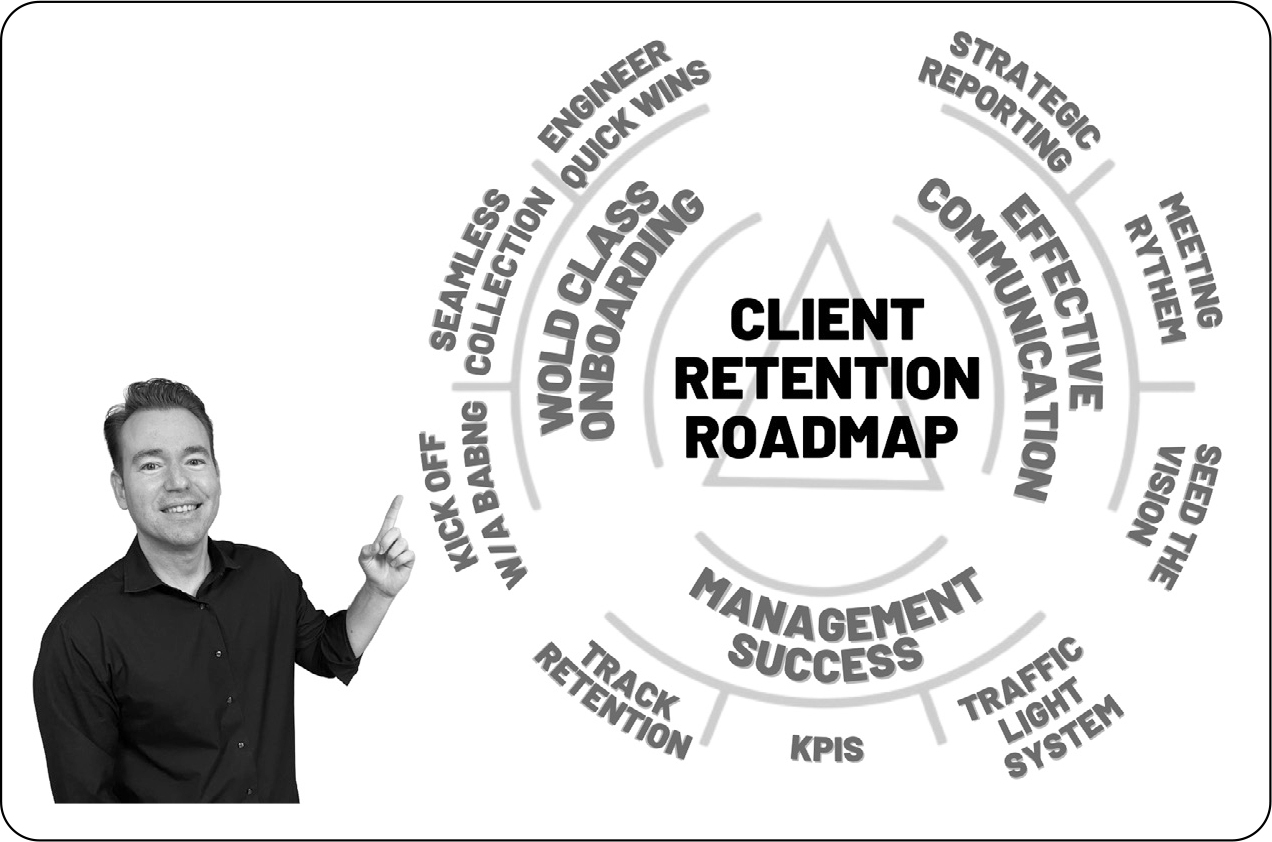
ONBOARDING | COMMUNICATION | CLIENT SUCCESS MANAGEMENT |
Dial in your onboarding process Setup a multi-step new client capture form to simplify to collection of login details Flesh out your “OnBoard Call” script Think about where you can engineer “quick wins” into your service offering Start sending a welcome / thank you gift (basket or custom box) to new clients Roll out an OnBoarding sequence to set expectations, indoctrinate in your process & enhance communication Start communicating every step of the way as micro-steps are complete in your OnBoarding process | Re-work your reporting to focus on the KPIs your clients care about most Map out your “Ideal Monthly Review Call” Commit to meet with every client at least once per month Build out a weekly touch process to connect with your clients, share outcomes / results & next steps Shoot a Loom Recap video for clients that can’t or won’t meet live each month Focus on seeding the vision & what you will be doing for them over the next 60-90 days | Account Management You’ll need a Full Time Account manager for every 25-30 accounts Develop Account Management Recruiting, Training & OnBoarding Process KPIs Setup your Sales & Retention Tracking Sheet and commit to know / track your Monthly Client Retention Rate Track your Account Management communication metrics Shoot or at least 97% monthly retention rate Traffic Light System Add all your clients to a success tracking mechanism where you can gauge who is Green / Yellow / Red Work your Client Success System weekly and proactively move Red’s to Yellow & Yellows to Green Setup your Client Account Management Snapshot on HighLevel |
I hope you find this whole book helpful, and I encourage you to work on your own roadmap.
I’m sure you’ll find that it helps you reduce the churn in your agency and keep more clients on board long-term.
If you are serious about growing and scaling your agency and want some help from me and my team, let’s jump on an Agency Acceleration Session.
Here is a link:
www.SevenFigureAgency.com/Schedule
On that call we will help to get clear on the fastest path to grow and scale your agency.
We’ll also discuss how we can work together to help you implement the strategies outlined in this book to improve your retention.
Thank you for spending your precious time reading this book. I hope it has been of value to you and will propel your business to new heights.
I wish you tremendous success and happiness. I look forward to meeting you in person soon.